Published: 28 May 2026 · Last updated: 28 May 2026
AI copywriting changes completely when it finally understands your voice instead of sounding like everyone else online.
You've had the words in your head before.
The right ones.
The clear ones.
And the version that actually says what you mean.
Then you sat down to write.
And the words came out wrong.
You edited.
You moved sentences around.
Then you wrote three more versions.
An email took an hour. Sometimes a day.
You may or may not know that I'm dyslexic.
So for most of my working life, that was just how it was.
And I just accepted it.
Then AI came along, and it sped things up massively.
But the drafts sounded nothing like me.
So I spent almost as long editing as I would have writing them from scratch.
I assumed the gap between the voice in my head and the voice on the page was just part of writing.
Then I built one document, and the improvement was instant and dramatic.
It's called a Brand Voice Guidelines doc.
A file the AI reads before it writes a single word for me.
Examples of writing I'm proud of.
Examples of writers I wish I could write like.
Rules for how I actually speak.
A list of words and phrases I'd never use.
Now an email takes minutes.
The draft usually sounds more like me than I do.
It says what I meant to say.
Just like this one does 😉
This week's podcast walks through how to build one for yourself.
Doesn't matter if you're on ChatGPT, Claude, or something else.
Have a listen – it might just be the thing that finally makes AI sound like you.
KEY TAKEAWAYS: The Systems Behind 10x On-Brand AI Copywriting
- Train AI in “Your” Brand Voice: Creating decent Brand Voice Guidelines enables you to quickly turn rambling voice notes into polished copy. Polished emails and marketing that actually sound like you wrote them.
- Create and Maintain One Source of Truth: Keep your guidelines as a single, central document that every AI writing project references. Include an exclusion list to stop AI from using cliches or phrases that don't sound like you and ensure it writes in an inclusive way.
- Use AI To Smooth Out Your Ups And Downs: A strong brand voice file lets AI keep your tone and quality steady, so your audience experiences consistent, confident communication even on bad days when your energy, focus, or mood fluctuates.
- Use Projects, Not One-Off Chats: Set up projects so you don’t have to re-upload your guidelines every time you start a new piece of content.
BEST MOMENTS: Insights On Human-Led AI Copywriting
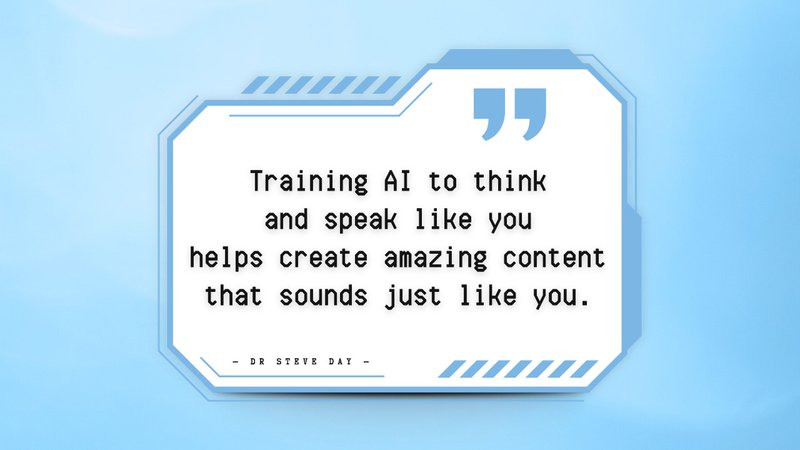
01:19 – 💬 “ Brand. Voice Guidelines are a document or set of documents that you share with the AI before you start writing any copy for any of your marketing, emails, or web pages.”
04:12 – 💬 “ Brand Voice Guidelines have transformed the speed at which I can produce content and also the quality of that content.”
08:35 – 💬 “ It (AI) can edit and do stuff on the fly while you're working with it, so it can be a self-correcting, iterative process that actually gets better and gets more intelligent, so to speak, as you are working with it.”
14:04 – 💬 “ Set up Brand Voice Guidelines, and it will transform the speed, quality, and ease of creating all of your content, forevermore.”
TIMESTAMPED OVERVIEW
00:00 Intro: AI helps articulate thoughts
03:49 Improving content with Brand Guidelines
07:34 Using AI to update branding
10:14 Why I switched to Claude
13:24 Creating effective Brand Voice Guidelines
Episode Transcript
Please note: This transcript was generated using automated transcription tools and may contain typographical errors or inaccurately captured words or phrases.
Dr Steve Day: If I could go back to day one of using AI, there\'s one thing I would do that would\'ve made things so much easier. And now I\'ve done it, it totally transforms how I interact with AI and also the outputs I get. This is all about building a Brand Voice Guidelines.
Today I wanna talk about why I did it and the difference it made overnight to the quality of stuff that came out. And also how you can actually go about setting yourself up, whether you are using OpenAI with ChatGPT or Claude or whatever else.
Okay, so when I started using ChatGPT to help me to write emails, et cetera, I used to jump on a chat thread and just basically ask it questions. I may post in a draft that I\'d done or I\'d do a little voice note and I\'d get it to draft something. And it came out pretty good. However, it sounded a lot like an AI, and actually, if you put it through an AI tester, it would actually pick it up as being AI.
So it was good, it was useful, it speeded things up. But it didn\'t really A, sound like me or B, actually do anything good for my brand. It didn\'t help people connect with me because it wasn\'t really me speaking. And this kind of put me off using AI for a while thinking it would never replace a human. But I did stick at it. I stuck at it a lot.
We went back and forth, we trying to working with things and eventually I came across this idea of building a Brand Voice Guidelines. This is a document or set of documents that you share with the AI. Before you start writing any copy for any of your marketing or emails or web pages or whatever it is. Or building courses or any communication you do.
You want to have to try to train it to think and speak like you. And done right, you can create amazing content that sounds just like you. Actually, even sounds better than you, but in your voice. It\'s the way you wish you could say things if only you\'re more articulate, that\'s why I feel like anyway.
And especially, because I\'m dyslexic. And I often struggle to get things out of my head down on paper in a way that makes sense. Without going back and forth and changing things for hours. This just massively accelerated my ability to create content that resonated. But it resonates not just with the people that are reading it, it resonates with me. It makes me feel proud of the stuff that I\'m saying.
It\'s, as I said, it\'s the way I wish I could say it. If only sometimes I could actually get the words out of my brain. It\'s the way I\'m thinking in my head, but I\'m sometimes not able to articulate it. And so the AI has actually helped me through training to get to a point where I can just speak my mind. And I make mistakes, and I \"um and ah\", and I repeat myself and I stutter, or I go back and forth. And just can be a bit of a mess, just a bit like this conversation now in some ways.
But then what the AI can do is put whatever I say, the rambles that come out of my mouth, put it against our Brand Voice Guidelines. And then create something that\'s polished, it\'s succinct and it just sounds like me. And it\'s the way, as I said, I wish I could have got it out first time without all the editing and back and forth.
So writing an email now will take me literally minutes to do. It\'ll come out perfect. Whereas before writing an email used to take me hours, if not days to do it. And that\'s what put me off doing it so much. I used to sit down and try and write stuff. Or I\'d try and do voice notes, then correct them and edit them. It just took me ages.
I was proud of what I produced from time to time. But it was often long-winded and actually, I\'m surprised if many people wrote it. Because sometimes I come out with like pages of stuff that actually didn\'t really get to the point home that I was trying to say. It was just an interesting story for anyone that liked to read them.
Now I can do things much more succinctly. I can also add in other frameworks and structures other people have created, like really powerful marketing frameworks. And then craft these emails into something more compelling and more emotionally driven. And more making people actually take note and actually take the actions that I want them to.
Not in a way that\'s manipulative or not in a way that\'s persuasive. Just because I\'m saying it in a way that\'s structured, that allows people to follow along with what I\'m saying. And actually come to the same conclusions that I have, which is why I\'m writing this stuff in the first place.
So that is what the Brand Voice Guidelines has done for me. It has transformed the speed at which I can produce content. And also the quality of that content coming out. And this is the absolute key for me going forward, or that I\'ve realized in recent times. Is that when you\'ve got this in place, no matter how much you may vary from day to day in your mood or the style of you speaking, the AI can actually help bring you back on track. To help everything align in a single Brand Voice.
This creates consistency in the way that you present yourself to the world. And people like consistency. People like to have their expectations met. So when they come across you wherever you are in social media, they get the same sort of feeling from reading your stuff. It\'s not like, whoa, I wonder what mood Steve was in today when he wrote this one, or whatever.
It\'s like it pulls it all into a nice, coherent brand. Not boring, not impersonal, quite the opposite. Something that is really rooted in who you want to be when you talk. And allows you to do so in a way without having to overthink it and over edit it. So I believe it\'s probably one of the most powerful things you can do.
It filters into so many different aspects of your business. As I said before, like if you\'re creating courses, emails, website copy, sales copy, written proposals. Whatever you are doing with your voice, as in writing or speaking. You can use this Brand Voice to actually help guide the AI to produce on brand content.
So the way we did this was pretty simple. You can ask the AI to build this for you. You don\'t have to do this yourself. The best way I found was to provide examples of stuff that I was quite happy with, of my own work. But I also went out and I found other people\'s work that I was really impressed with that I thought, God, I wish I could write like that. That sounds like, that\'s how I wanna write. That\'s how, what I\'m thinking in my head. But sometimes I can\'t get the words out.
And I got those examples. Some from one of my coaches, for example, and I got some of his emails and social media posts. And I put them into it as well. And then I asked the AI to produce a Brand Guidelines Document, and that document then came the single source of truth. It contained things like examples of previous stuff I\'d done. It contained rules, say for example, to use \"I\" instead of \"we\" and \"our\". If you wanna talk about yourself, also be inclusive when you\'re talking about other people.
Things about, you know, making sure it\'s totally ethically correct. You are inclusive in everything you say. You\'re not excluding people by the terms of what you\'re saying. And any other tones and style guidance that you can give it. Having a list of words that are excluded or not allowed, basically, when the AI is writing is also really, really powerful. It\'ll often throw in so many cliche phrases.
And the reason I\'m writing this is because just now, I picked up that there was one that I\'d missed before, and it was like, the honest truth. And I keep on saying it, seeing this in some of the emails that have produced. Or the truth is this, the honest truth. And to me that sounds just cliche. It sounds like either marketing guy\'s written it or girl. Or it could be that, or it\'s an AI that\'s written it. And so I simply just said to the AI, hey, can you update my brand to exclude that phrase as well, because it doesn\'t sit with me. I don\'t like it.
And because I\'m using an app called Claude Code, it can even do those updates for me. I don\'t have to actually go and edit any files, which I have, I used to have to do when I was using, say, ChatGPT. Instead, I can actually ask the Claude Code to just go update it for me.
Now, Claude Code is a more technical way of using AI. But if you are a slightly techie person or you wanna just jump in and have a go, it is super powerful. Because, as I said, it can edit and do stuff on the fly while you are working with it. So it can be a self-correcting, iterative process that actually gets better and gets more intelligent, so to speak, as you are working with it.
That is one of the greatest things, the revolution in AI in very, very recent times. Which is transforming the way I work and the people around me. So if you wanna build this for yourself, it doesn\'t matter if you\'re using Claude Code or not. You can do this in ChatGPT or just a normal Claude Chat.
What you need to do is to set up a project so you\'re not always having to supply this information. If you just use a general chat, then you\'d have to typically upload your Brand Voice Guidelines or attach it to every chat thread you use. So that the Claude will then, or the AI will then know, okay, for this context, I\'m gonna use this Brand Voice Guidelines.
So instead, you can set up what\'s called a GPT in ChatGPT. Which is like a project where you can put files in. You can also set up a project in GPT and put the files there as well. You can also use a project in Claude. You may be familiar with these, which is great. And this is a great example of a, of where you should be using something like a project. So you can have a standard document that\'s always referenced whenever you\'re using that particular project. And therefore all your chats will actually reference that document.
And similarly, if you are using something like Claude Code, you can set this up as an MD file. I have this as a global file, a global rule. So any of my projects I set up at anywhere in Claude Code, will always reference my brand. Whether I\'m doing a sales or marketing or courses. Those are all different setups, all different projects within my Claude Code. But they all reference this global central document or set of documents. Actually, I\'ve got a few for different aspects of the brand.
And that means I\'ve not got duplicates of them. Because if you have a separate project, say for your marketing. You have a project for your sales. And you have a project for your courses. Which I recommend, by the way. I don\'t think actually having all of those in one is great. Because you wanna be able to give specific sets of instructions around the kind of work you are producing.
So if you split out into those projects, then you\'ve gotta then have a separate copy of that brand in all of them. One thing I love about Claude though, is even if you do use the projects in Claude, you can link it to say a Google Doc. And that Google Doc can be a single source of truth. And therefore you can update that Google Doc in one place and it\'ll automatically reflect in all of your Claude projects.
At the time I last used OpenAI or ChatGPT you couldn\'t do that. You had to upload the file. If you wanted to make a change to it, you had to delete it and re-upload it. They may have sorted that out now. But the time I was last, using it properly before I switched over to Claude, that was a problem.
That\'s one of the things I loved about Claude. That you could have this centralized document on your shared drive in your Google or whatever you\'re using. And it will then actually be able to use that as a single version of the truth. So whatever project it\'s put into, it will then always use the latest version. And similarly, if you\'re using Claude Code, you can do a similar thing. Where you can have this as a central document, a set of MD file it\'s called, across all of your projects.
So, that\'s it. If you want to radically improve the quality of the output you get from any AI you\'re using. With the terms of the written content that you produce. I highly recommend you set up a Brand Voice Guidelines document. There\'s loads of info out there, or just literally ask the GPT, or sorry, ask the AI to do it for you. And it\'ll guide you through the steps.
There\'s, I\'m sure lots of frameworks out there you can go and grab, and say, hey, build a Brand Guidelines just like this. And ask me all the questions. So ask the AI to ask you what it needs in order to do it really, really well.
And don\'t take, you know, mediocre as okay. Go back to it and say, what else do you need? What else can I give you? What else can we make it even better? How can we improve this? Like, keep on asking it until you get something that literally every time it writes for you, you\'re like, bang on, that\'s it, I don\'t need to make any edits.
I now probably edit, like every email that we put out, I may make edits on say, one in three. And that will just be one sentence where there\'s something that\'s not quite right. I could easily send it out. But it\'s often just these little phrases that creep in. Like I was saying before, like \"the honest truth\". Like I don\'t like that phrase. Maybe you do, but I don\'t. So I decided to add that to my exclusion list. And that was the type of tweak that I make.
But I\'m a systems guy as well. So I love this idea that I make that tweak once, I update the system, and never again do I have to ask the AI to exclude that particular phrase. The other massive advantage of having an exclusion list is you can make the AI un-AI-detectable.
So when I put my emails or any content I do now through an AI detection app, it comes back with 0% AI. That\'s because every AI phrase that is commonly used. Every expression, the way it uses emojis, the way it uses dashes, we forbid them in the emails that we create or the content that we create.
And therefore, it\'s impossible, as of today, for the AI checkers to actually see that this is written by an AI. Because we\'re not tricking it, we\'re just being sensible. We\'re just stopping the AI doing the things the AI would normally do that give it away. So doing this not only makes your content better, it\'ll make it more searchable on the GEO. So the Generative Search Engine Optimization type of stuff. Because it won\'t get flagged up as AI. And it just makes you sound brilliant.
So, if you\'re gonna do nothing else today or nothing else with AI this week, do this one thing. Set up a Brand Voice Guidelines. And it will transform the speed, quality, and the just ease of creating all of your content forevermore.
Hope you enjoyed this. If you did, please do hit subscribe. So you get more tips on using AI automation and other cool things to live with more presence, purpose and peace. And please do share this episode with any other business owners, you know. Who you think might benefit from hearing it.
Thanks so much, I\'ll see you again.
VALUABLE RESOURCES
Join our private, focused, and supportive community designed for freedom-driven entrepreneurs at join.sys.academy
LINKS TO CONNECT WITH THE HOST
- Podcast: https://www.systemizeyoursuccess.com
- Website: https://systemsandoutsourcing.com/
- Facebook Group: https://facebook.com/groups/systemsandoutsourcing/
- LinkedIn: https://linkedin.com/company/systemsandoutsourcing/
- Instagram: https://instagram.com/systems_and_outsourcing/
- YouTube: https://youtube.com/@drsteveday42
- TikTok: https://www.tiktok.com/@drsteveday42
ABOUT THE HOST
Steve moved to Sweden in 2015 and transformed how he ran his businesses—switching to a fully remote model. A former NHS doctor, with a background in computing and property investing, he now helps overwhelmed business owners systemise and outsource effectively. Through his courses and coaching, Steve teaches how to automate operations and work with affordable virtual assistants, freeing up time and increasing profits. He runs his UK-based businesses remotely with support from a team of UK and Filipino VAs, and is passionate about helping others build scalable, stress-free companies using smart systems and virtual support.
For more articles related to AI copywriting and content creation, you may also like:
My Journey to AI-Enhanced Copywriting: Cutting Costs without Cutting Corners
Using Artificial Intelligence to Write Contents for Social Media and Podcasts