Published: 25 June 2026 · Last updated: 30 June 2026
The most effective AI strategies start before you build anything – discover how planning first saves time, energy, and unnecessary complexity.
AI was supposed to give me my time back.
Some weeks it does the opposite.
I go in to save an hour and come out hours (if not days) later with a clever thing I built and a nagging sense I didn't need it.
You might know the feeling.
You're busy. Probably doing too much yourself.
So when everyone online promises that AI is the silver bullet, you reach for it.
And the promises are real.
AI can solve a huge amount.
But not without a lot of effort up front.
Most of that effort gets wasted when there was never a plan behind it.
I've seen this before.
Outsourcing. Automation. Chatbots.
New shiny penny, different year. Same mistake.
Here's what I've learned.
If a tool isn't saving you time today, it's just adding to your workload.
So before I build anything now, I spend five minutes on a Project Vision Plan.
Does it fit where the business is going?
Does it solve a real problem I have right now?
Will I actually feel the benefit?
It takes five minutes, and it's saved me weeks.
And there's a step most people skip before AI ever gets near the job.
Earlier this week, my new assistant took over checking my calendar.
First time through, she caught gaps I couldn't see.
We fixed them together in about half an hour.
Now I could hand that job to AI tomorrow – because a person tested it first.
I walk through the whole thing in this week's episode.
The planning, the order to do it in, and why a human should almost always go before the robot.
Have a listen.
KEY TAKEAWAYS: Practical AI Strategies That Save Time and Reduce Complexity
- Don’t Let AI Create Extra Work: Without a clear strategy, plan and documenting progress, AI projects become shiny distractions that burn time and add to your workload instead of removing it.
- Systemise Before You Tech‑ify: Use a Personal Systemisation Plan to capture what you do, prioritise high‑impact, low‑complexity tasks, and choose whether a human, automation, or AI is really the best next step. Before handing it over, be sure you have captured the process accurately.
- Delegate Like a Pro (to Humans and AI): Clear instructions, deliverables, and boundaries, backed up by solid documentation, are what make both team members and AI reliably perform the way you intend.
- Avoid AI‑Driven Feature Creep – Work In Phases: Break AI and systems projects into small stages that each deliver real value, get them “over the line” and in use, then iterate. This avoids half‑finished monster projects that consume time but never pay you back.
BEST MOMENTS: The AI Strategies Behind Sustainable Growth and Freedom
03:01 – 💬 “AI can actually solve huge amounts of problems, but not without putting a huge amount of effort in upfront.”
04:18 – 💬 “The documentation of the system is as important as the planning of the system – both must happen before you build it.”
16:22 – 💬 “We need to be really, really defined in the way we ask the AI to do something, just like you do with a human, just like you do before you plan an automation.”
17:17 – 💬 “If you don't map out what your automations are doing or what your AI is doing, people won't know when stuff is done by or whose responsibility it is.”
23:19 – 💬 “It's about actually having a systemized approach to reviewing what it is you're going to be working on next and making sure you follow that system.”
TIMESTAMPED OVERVIEW
00:00 Intro: Challenges in Implementing AI
07:30 Creating a Personal Systemisation Plan
10:01 Improving the assistant handover process
14:01 Avoiding AI memory overload
17:58 Importance of process mapping
19:09 Business growth through project planning
22:58 Planning and prioritising projects
Episode Transcript
Please note: This transcript was generated using automated transcription tools and may contain typographical errors or inaccurately captured words or phrases.
Dr Steve Day: There\'s something important that very few people seem to be talking about when it comes to AI. This isn\'t anything new. And that old phrase of history repeats itself seems to be happening all over again. Whether it\'s been outsourcing, automation, chatbots, whatever the new fad of the week is. People seem to forget something really, really important.
Today, I wanna talk about what I believe that is. And also what I\'m doing in my company to make sure that we don\'t fall into the same trap that I\'ve fallen into previous times similar things have happened.
Okay, so today\'s episode is all about the observations I\'ve seen both internally in my company. But also very much in social media and listening to clients\' experience of working with AI. And also people I\'ve been working with very closely on building some pretty cool complex AI stuff as well.
This can be anything from using AI to help you to write an email post, do some brainstorming, or build some complex app. That literally takes over an entire part of your business. The problem that I\'m talking about here is the same problem I saw when I got into outsourcing. The same problem when I started building chatbots, the same problem when I started doing automation or building APIs.
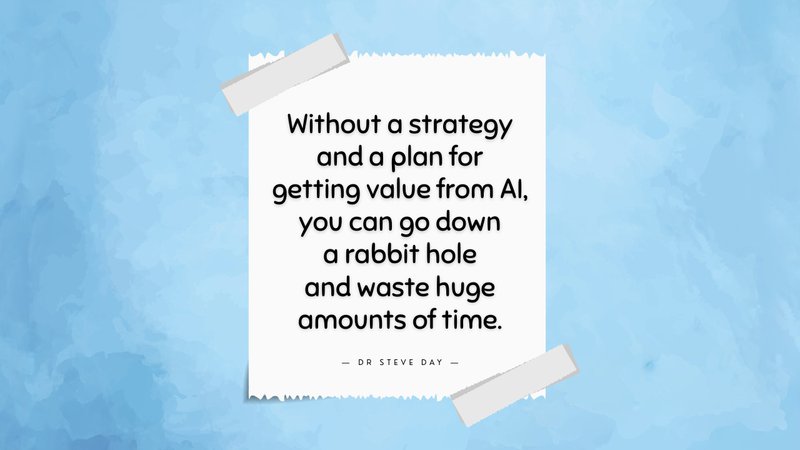
And the challenge is that unless you have a strategy and a plan. To understand how to actually get benefit from whatever technology it is that you\'re using in the present moment. You can go into a rabbit hole, you can waste huge amounts of time. You can end up systemizing or, sorry, using AI to develop something that wasn\'t really necessary, you weren\'t doing anyway. And actually isn\'t gonna save you any time.
And the problem with this is if it\'s not ultimately saving you time today, it will just end up adding to your existing workload. Now, if you\'re in the lucky position where you have an abundance of time. You have resources, you have brilliant staff, and they\'re able to help you to develop this stuff going forward. And you\'re able to actually spend your time working on strategy and planning and deciding exactly where you should be putting your finite resources. Then brilliant.
But most of the business owners I speak to aren\'t in that privileged position. Most are still doing a lot themselves, arguably too much themselves. And they\'re busy and trying to find ways to save time. They\'re going to AI to provide that silver bullet or that elixir which is gonna take away all of their challenges.
The promises that people talk about on social media are huge. And yes, they are available. They will - AI can actually solve huge amounts of problems. But not without putting a huge amount of effort in up front. They can help to develop so much of what you\'re currently doing into something better. But at the cost of you having to spend many, many hours figuring out how to make it work or investing in someone to help you do that for you. And trial and error, and testing stuff out, and connecting the dots.
And herein lies the problem. That even if you can do all that, if unless you document what you\'re doing, unless you actually put systems in place. Or document the system that you\'re putting in place, sorry. Then maybe only you will know this thing, this brilliant AI thing that you\'ve created. Whether it be just a simple chat thread or a project or a custom skill or an entire application you\'ve built with API.
Unless you\'re very careful, the same thing will happen with AI, has to do with chatbots or with automation. In that you create something, you get it deployed in your business, but nobody else knows about it. Except for maybe the person who helped you deploy it. And the problem is when that person leaves, which inevitably they will at some point, that knowledge goes with them.
So the documentation of the system is as important as the planning of the system, which both must happen before you build it. And yes, you can do it in reverse order. If you\'ve already built stuff or you\'re halfway through and you come up with an idea and you get excited and you get started. But at some point you\'ve got to stop before you go onto the next thing and the next thing.
Or before you keep developing the thing you\'re working on right now. Is to just pause and say, \"Look, did we actually have a business case for doing this in the first place? Did we put the planning in to think, you know, should we be doing this today? Or should we be waiting till something, some of the needs are satisfied first, some higher priority needs? That\'ll actually serve us to save us some more time right now to give us the more time we need to do all this other cool stuff in the future.\"
And then once we made that decision, then we made a business case for it to say, \"Yes, there are real challenges that are gonna be solved by this, yes, the benefits are obvious. Yes, it\'s in line with our quarterly and our annual goals, yes, the outcome will actually serve us as a business in get moving towards our vision and in line with our values as well.\"
Once you\'ve decided all those things, then yeah, go for it. Develop this thing, whatever it is, using AI or automation or whatever it happens to be at the moment that you\'re working on. But until you\'ve done all that, then actually you could end up using up huge amounts of resources. Whether that\'s your own time or your money paying for other people to do it. Or just taking your team off other projects. And the opportunity costs of doing that are just as important and costly as in real terms, real money that you\'re paying out for someone else to do it.
So we\'ve got to be super careful that we don\'t actually just jump in at the deep end, try stuff out, and it actually not give us immediate benefits. So a couple of things that I do or try to do every single time. And I\'m gonna hold my hands up and say that I don\'t always do this, and this is why I\'m recording this podcast. Because even someone like me who is super conscious of this and makes this mistake very often, that\'s why I built these frameworks. Even now I still make this mist- these mistakes.
So that\'s exactly why I\'m recording this podcast. And so the strategy or the frameworks that I put in place to do this are to have something called a vision document, a project vision document. And that helps me just to - it can take five minutes to put it together. Or if it\'s a complex project, it may take a bit longer. Just to put the business case forward. So answer those questions that I just talked about then.
Like, does this project align with our values and our vision and our mission? Does this project solve real life challenges that are happening right now? And does it have real term benefits or tangible benefits that we will see as soon as this is developed or deployed? Do we have the resources and the knowledge available right now? Or do we need to factor those into the cost of doing this?
If you\'re not currently deploying apps on, you know, Coolify and VPS and all the rest of it. And using Claude to build all that sort of app stuff, you\'re not doing all that. The cost of actually figuring out how to do any of that is huge. And I know because I\'ve just done it, and it\'s absolutely massive, and getting it right and breaking stuff and all the rest of it. And it could be something small that you\'re building, or it could be something big. But having a very quick sense check before you get started is super important.
Now, let\'s just take it actually ste- a step back. Because, I think rather than getting actually into the idea of, you know, building a project, let\'s just go really simple. And let\'s just say that you\'re gonna use AI to help you do something that you currently do in your business.
Now, whether this is AI helping you, whether this is you outsourcing or delegating this task to a member of staff or a virtual member of staff. Or whether it\'s you building an automation or using APIs or whatever it is you\'re gonna do. The idea of you moving stuff off your plate onto somebody else\'s is hugely attractive.
But we\'ve got to do this in a logical order. We can\'t just go, \"Hey, I\'m just gonna do everything.\" Because then you\'ll do nothing, because you\'d be so distracted by doing too many things at once. So you need some way of rationalizing all the stuff you\'re currently doing that you wish you weren\'t or that you know you shouldn\'t be. Or that you think, \"Look, I could just get someone else to do this. It would actually make my life a lot happier, and I could focus on some higher value activities.\" Whether that\'s inside or outside of your job.
And so having a systemized process to deciding what to focus on, in terms of moving it off your plate is the same. Regardless of if it\'s AI, automation, virtual assistant, or something in between. And so the way we do this is something called the Personal Systemization Plan. And it\'s very simple that you just note down what you do. So capture what you do is the framework that we use for this. And then we look at how long things are taking you and how complicated they are. It\'s nothing much more than that involved in it.
And then you get a list which gives you a priority of the stuff that\'s taking a long time. It\'s not very complicated, so therefore it\'s easy to hand over. And it\'s something id- ideally that you really hate doing as well. That\'s sort of the icing on the cake if you can move that stuff over. And then you know, like, if you do this every day and it\'s taking a while, that\'s a high-cost task in terms of time. And so therefore it\'d be a great thing to get onto someone else\'s plate.
If it\'s income generating, then that\'s another reason to get it off your plate. Because then you can generate more income by getting more people to do it. So there\'s different factors you can put into to refine the priorities. But ideally you want to have stuff that\'s taking a long time you can move over relatively easily.
Once you\'ve got that in place, so once you\'ve got your Personal Systemization Plan, you then need to decide what is the best method to move this off your plate. And AI may be the answer. But it may not be. And probably not until you\'ve at least given it to someone else to do first, and there\'s a big reason why we do this as well.
And I\'ll give you a real-life example from today, which was in a meeting earlier today. My assistant, who\'s just taken over the role of my admin assistant in terms of checking my diary. And she said, \"Hey, Steve, this is the first time I\'ve done this. Bit confused by the instructions. Can you just give me a hand?\" And we looked at the instructions that had been handed over from her predecessor. And she was right.
They weren\'t actually very clear. And it was something that I\'d been working on with her predecessor. We\'d never quite polished it off. And it was pretty confusing. There were some conflicting rules.
And just to put it in context, this is about my assistant checking my calendar for the month ahead. She does this on a weekly rolling basis. To make sure there are no conflicts, that all calendar links have been set up so meetings happen when they should. That I\'ve not double-booked with my own personal holidays or a bank holiday. Which I often do because I don\'t notice there\'s one coming up. Or yeah, anything in between.
Making sure basically my entire diary, my life, is all organized for me. And this is something that I\'ve been working with one of my other assistants to do. But the documentation hadn\'t been as good as I thought it had been. And so when this was handed over, there were some questions. Had, for example, I\'d handed this over to an AI, the same questions would\'ve come up.
But the problem is the AI, it may be take me longer to get through this with the AI. Because you\'re sort of like trying to interpret why it got stuff wrong and go back to it. And this conversation happened within a few minutes with my virtual assistant, and it flagged up, yeah, there were some issues that we needed to address.
And then I was able to work through them with her and actually use someone else as a sounding board with a common sense approach to this. Which helped us within, you know, half an hour or so, refine the rules, make a process really, really tight. And now I feel I\'m in a position where, yeah, I could get an AI to do this.
But had we jumped in and said, \"Hey, I\'m - I don\'t have anyone to do my calendar management. Like, it\'s not documented at all. I\'m just gonna get AI to do it for me.\" That would be really challenging. Because I\'ve not tested anything. I\'ve not had any ideas about this before. I\'m just sort of going in blindly.
So because I\'ve been working on this for a number of months with my previous assistant. And then we\'ve now done this little refinement as we\'ve handed it over to somebody new. I\'m now pretty confident I can build an AI version of my calendar checker role, pretty damn quickly and easily. Because it\'s tried and tested.
So, thinking about this is like when you\'ve got your priorities list, make sure you\'re not jumping into the wrong solution. And automation was a great example of this, of the same issue. That it\'s really attractive to automate something. Because it means it\'s done forever without any interventions or costs. And it\'s incredibly powerful.
Like I have automated 90% of my business. I absolutely love automation. And it means that I can actually get my staff to do the stuff that is really difficult to automate. The bits that involve humans and brains and common sense and stuff. And things that I want decisions made of based on the current circumstances. Which automation can\'t handle. AI can plug some of those gaps automation had. Which is really attractive to someone like me. But I still want humans involved at some points.
But the point here is that, jumping straight into a tech solution without testing what it is you are doing first. And being sure that you want this to be done forevermore going forward. That can be hugely costly in terms of the unexpected problems that always come up when you\'re using technology. And that goes for automation. It went for chatbots, when we did automated chatbots with ManyChat and things. And the same thing is true for AI.
Yeah, AI is great at lots of stuff. But it is also great at telling you what you want to hear. About making assumptions about stuff that isn\'t real, about making stuff up. Now, you can mitigate some of this by really good prompting. And using things like, compacting your conversations, or having handover documents. And making sure the memory of the AI never fills up.
Because just like a human. When you fill the AI memory up, and that\'s like the conversation thread you have in a chat, for example. When that fills up, it starts forgetting stuff. It makes stuff up. It gets confused. And there\'s some really good reports on this. That show that actually, if you\'ve got two or three different pieces of information which are similar, and they could be right. But it needs to have some judgment to make sure which one is right, that can massively decrease the accuracy of the AI.
Similarly, if you have too long a threads. If you post too long, much information. You don\'t compact, or you don\'t hand over to a, new conversation. That has a hugely detrimental fact, impact, sorry, on the AI\'s ability to do the work in the way that you expect it to.
So making sure that we\'re not just jumping into AI. Because it\'s all the rave or all the whatever at the moment. And making sure that actually you\'ve got a business case for it. You\'ve put some planning into place. You\'ve tested it out using humans in the majority of cases. Those things will really help make sure you don\'t end up going down a rabbit hole. And just wasting huge amounts of time
The last thing I just want to mention today is - two things actually. One is two skills which are essential in this. And these have been essential since the day I started, and they\'ve been essential like 10 years ago in my current business. And these have been essential for decades. If not centuries before now. And that is how to actually effectively delegate. Because that skill is now more important than ever.
Because if you can effectively delegate a task, it means that you can give it to a human. You can give it to an AI. You can get someone to give it, build an automation with you. But you have to be able to do that effectively. Just saying to an AI, \"Hey, can you just sort out my calendar for me?\" isn\'t gonna get the result I want.
I have a very specific way that I want my calendar sorted, I have priorities about what takes precedence if there\'s a conflict. I have certain criteria that need to be met when doing things like sending out Zoom links to meetings, like are they a client? It\'s much more than just saying, \"Hey, do my calendar management.\"
Same with emails. You can\'t say to an AI, \"Sort my emails out.\" It\'ll do something, but it won\'t be doing what you actually want it to. It may help a bit, but it\'ll probably screw things up as well. So we need to be really, really defined in the way we ask the AI to do something. Just like you do with a human, just like you do before you plan an automation. And that skill hasn\'t gone away. It\'s actually become more important.
Because if you can give AI really clear inputs, really clear deliverables, and really clear boundaries. And then give it access to everything it needs. This is using my DIDACT model, which I\'ve developed over the past 10 years. It\'s exactly the same information that I would\'ve given to a virtual assistant or a staff member. To actually go away and do the task effectively first time and every time. So it\'s just showing me how important creating systems in a structured way is.
The second skill is process mapping. Because if you\'re involving AI in a part of a workflow, that means we\'re gonna be interacting with humans and AI. Just like we used to interact with humans and automation. But if you don\'t map out what your automations are doing or what your AI is doing, people won\'t know when stuff is done by who or whose responsibility it is.
So process mapping is the way that we do that. And it\'s something that putting some effort and time into actually learning how to create good process maps now, is just one of those fundamental business skills. That give you the freedom to get your vision and turn it into operational flow in your business. And that to me is one of the most valuable things you as a business owner can do.
Yes, you could pay someone great to do that for you. You tell them that the project vision that we talked about before, and let them figure out how to do everything. But if you\'re a business owner like me who quite likes the idea of well, not quite likes the idea, I enjoy the process of developing systems, I enjoy that. And I want to actually understand how things work in my business.
So if you are that kind of person and you don\'t wanna just sort of hand over and, you know, let other people take care of it. And you have no responsibility for how it\'s built, then fine. But if you do wanna keep hold of some of that, then process mapping is the skill you need in order to do that efficiently and effectively. And allow people to understand very clearly what it is that you are talking about.
So we talked about planning. We talked about making sure that we\'re prioritizing our systems. We\'ve talked about how you actually delegate, and systems creation, and systems mapping. And if you do these things, then you can be sure that, A, when you start any AI or any initiative to move stuff off your plate, whether it\'s AI or otherwise.
If you start that process, then you\'re actually heading down a path which you should be going down. Because you can see that at the end of this, it\'s gonna save me X amount of time, it\'s gonna generate me X amount of revenue. It\'s gonna be able to let me grow my business. It\'s gonna free up someone else\'s time. Whatever those bonuses are, you\'re gonna have documented it.
You\'re also gonna have a plan of how you\'re gonna go about this. And know that this is actually a high priority thing that you should be moving over. And you\'ve not just randomly picked something because it seemed like a good idea at the time. You\'ve put some thought into it, you\'ve got some numbers behind it. You know how much this is gonna actually benefit you.
And you\'ve sat down for a few minutes and put a business case behind it. And then just planned out using process mapping or a checklist. Or whatever you\'re familiar with. And actually said, \"Okay, what are the things that I\'m gonna actually build here? What is the order things are gonna get built?\" And can you actually, as a final thought, can you break a bigger project down into phases?
So phase planning is one of the most powerful things I\'ve ever done. I\'m brilliant at starting things. I\'m terrible at finishing them. And so I need to break bigger projects down into small deliverables. And I want those deliverables to actually deliver value to my business.
So for example If I was - when, I was moving onto my new course platform, I had this vision of all the whole course platform would do. All this cool stuff. The AI things we\'ve got in there, the knowledge base in there. All the transcripts for the lessons. The universal search. All my podcasts in there. Like, all my courses moved over. All my community there. We\'ve got agent- AI agents helping people out in the community.
All this stuff which is now in there, which has taken a couple of years to actually get there. But that was my vision at the beginning. But I broke it down into manageable pieces and said, \"Okay, great. What\'s the first thing we\'re gonna get?\" And that is literally just getting the people in there with a basic structure.
Then what\'s the next thing we\'re gonna do? Okay, we\'re gonna get some courses in there. Get that finished off. What\'s the next thing we\'re gonna do? Okay, we\'re gonna look at AI agents. By breaking it down, rather than trying to attack everything at once, I\'ve enabled me to actually deliver more and more value to my clients and actually to my staff as well. As we\'re going through this process of development.
It\'s the exact process that software developers do. They\'ll release version one of the app, then version two of the app, version three of the app. And you\'ll get more and more features as the app is developed. And that\'s where I got the idea from. From something called Agile Project Management. Which was developed for software development. But I use it for nearly every type of project I ever do, no matter how small it is. And AI is a brilliant example of a tool that allows you to have feature creep really easily.
So feature creep is when you start off with one vision in mind. And then you come up with a new idea and a new idea and a new idea. And you never actually get anything finished. Because you keep on adding new features to actually work on. And so you don\'t ever get anything over the line to 100%. It all sits around 80%. Nobody benefits from it. And it just causes pain and frustration in the team. And you don\'t actually get over the line, and people don\'t, you know, get the value from what you\'ve been working on.
So being really mindful of this and using something like Agile Project Management. And it\'s a bit complicated for most people, Agile. But I break - I\'ve made a simplified version of Agile, which I call Dev Projects in my Asana workspace. And that\'s how I break things down into phases. I plan it into different compartments. And then I can see exactly, you know, what features, what tasks are required to complete each stage. And I have a sign off that stage, and then, \"Yes, great. Celebrate that.\"
And then is it time to move on to the next stage? Or do we need to focus on something else? And it allows me to work on things, park them for a bit, go and do something else, come back, pick it up where I left off. But actually it\'s not just parked there doing nothing. It\'s parked there and at a point where it was delivered to the client or delivered to my staff. It gave value, but there is more we can do going on later. So. That\'s the final, final thought for this conversation.
Awesome. Well, hope you found that useful. To summarize what we\'ve talked about today, it\'s just all about proper preparation and planning. It\'s about actually putting a business case towards anything you\'re doing with regards to AI, automation or otherwise.
It\'s about actually having a systemized approach to reviewing what it is you\'re going to be working on next. And making sure you follow that system so you don\'t just pick things at random. It\'s about having a planning system in place to allow you to actually plan out that project, however small it is.
And then finally, make sure that you are, yeah, focusing on the stuff that actually makes your life better. That gives you more time. And you\'re not creating more work for yourself. When ideally we wanna create less need to work and more want to work. And AI is a tool that can help you do that if you\'re mindful about how you apply it.
Hope you found this useful. If you have, please do hit subscribe. And don\'t miss out on future episodes around AI, automation, VAs, and all other cool things to make your life - make you live with more presence, purpose and peace. And yeah, please do share this with anyone else out there who you think might benefit.
Thank you very much. See you next time.
VALUABLE RESOURCES
Get free access to our DIDACT Framework for quickly capturing the HOW of tasks and delegating them effectively at sys.academy/guides
LINKS TO CONNECT WITH THE HOST
- Podcast: https://www.systemizeyoursuccess.com
- Website: https://systemsandoutsourcing.com/
- Facebook Group: https://facebook.com/groups/systemsandoutsourcing/
- LinkedIn: https://linkedin.com/company/systemsandoutsourcing/
- Instagram: https://instagram.com/systems_and_outsourcing/
- YouTube: https://youtube.com/@drsteveday42
- TikTok: https://www.tiktok.com/@drsteveday42
ABOUT THE HOST
Steve moved to Sweden in 2015 and transformed how he ran his businesses—switching to a fully remote model. A former NHS doctor, with a background in computing and property investing, he now helps overwhelmed business owners systemise and outsource effectively. Through his courses and coaching, Steve teaches how to automate operations and work with affordable virtual assistants, freeing up time and increasing profits. He runs his UK-based businesses remotely with support from a team of UK and Filipino VAs, and is passionate about helping others build scalable, stress-free companies using smart systems and virtual support.
For more articles related to AI strategies and systems planning, you may also like:
The Four-Stage Systems Blueprint That Keeps Your Business Running—Without Relying on Key Individuals