Published: 11 June 2026 · Last updated: 11 June 2026
AI integration isn't about replacing your humanity—it's about creating more space for the work only you can do.
Most people I talk to are worried AI is going to turn them into a robot.
That their writing will sound generic.
That their work will lose the thing that made it theirs.
And that somewhere along the way, the human bit gets quietly squeezed out.
I get it. I've felt it.
But honestly? I think it's the wrong worry.
I sat down this week with Taylor Jean Anderson – she's a friend, and we've been swapping AI ideas back and forth for months. She said something that stopped me.
Used properly, AI makes you more human. Not less.
Think about what AI is actually good at.
The admin, the formatting, the repetitive writing.
The bits of your week that drain you and that nobody started a business to do.
Now think about what only you can do.
Sit with a client when they're in a hard moment.
Have the conversation that needs to happen.
Notice the thing your team can't see yet.
Build the relationships.
Be present at home.
AI doesn't take that bit. It gives you more of it.
Because every hour it clears out of your week is an hour you get back to spend on the work that actually needs a human in the chair.
Taylor and I got into how she's set hers up.
The way she's taught it to sound like her, not like everyone else.
How she uses it as a thinking partner rather than a robot to boss around.
The mistakes she sees people making when they try.
If you've been holding back on AI because you don't want to lose what makes your work yours – this is the one to listen to.
Have a listen. Honestly, one of my favourite conversations this year.
KEY TAKEAWAYS: How Strategic AI Integration Supports Human-Led Success
- Let AI Do the Robot Work, So You Can Do the Human Work: Most founders are drowning in tools and still doing low‑value work. You can flip that.
- Use AI as a Thought Partner, Not a Typist: When you teach AI your offers, goals, and worldview, it stops spitting out generic answers and starts challenging your thinking like a strategic business partner.
- Don’t Systemise What Doesn’t Exist: Fancy workflows can’t fix unclear offers or missing foundations. Validate first, then build. Ask whether I need this yet? What business problem does this solve?
- Build a Second Brain from Your Own Data: Your coaching calls, sales calls, and content already hold the answers for your business. Use AI to mine your archive, find patterns and leverage what you already know. It is easier than you think and can be built to automatically update.
BEST MOMENTS: Powerful Perspectives on AI Integration in Business
02:57 – 💬 “When you utilise AI the correct way, it can actually make you more human.” — Taylor Jean Anderson
17:46 – 💬 “It's that ability to have that business partner you don't really want, but you need …. we can actually create an all-knowing business partner who has not got any ulterior motive other than for you to succeed” — Taylor Jean Anderson
32:30 – 💬 “I'm talking things into creation that previously would have been either very, very expensive, or taken too long.” — Dr Steve Day
TIMESTAMPED OVERVIEW
00:00 Intro: The “AI Overwhelm”
01:00 Use AI to achieve harmony in life
09:40 Building robust AI systems that work
26:53 AI tools that work right out of the box
Episode Transcript
Please note: This transcript was generated using automated transcription tools and may contain typographical errors or inaccurately captured words or phrases.
Dr Steve Day: If, like me, you\'re feeling a little bit overwhelmed by the whole AI thing. All the technology and systems out there. That are just changing day to day beyond anything we\'ve seen in a long time. Then please check out this episode. Because me and Taylor Jean go into a meaningful conversation about what these massive changes in technology, in AI. What that means to us as people, as humans, to our staff, to our workforce. And how we can embrace this stuff and not let it become overwhelming.
As someone who loves technology, this is a very exciting time for me despite the overwhelm. And today\'s episode was a amazing chance to explore some of the stuff that I\'m massively interested in with somebody else who\'s also interested in this stuff too.
And if you wanna have a chat with Taylor after listening to this episode, then please head to royaltstudio.com. So royal, letter T, studio.com, or go to Instagram and find her at adaywithtaylorjean. Hope you enjoy this episode as much as I did recording it.
Taylor, real, real pleasure to have you on the show. Really excited for this conversation.
Taylor Jean Anderson: Likewise.
Dr Steve Day: Cool. For those of you that don\'t know who, but know probably will, me and Taylor do know each other. We\'re actually on the same coaching program. We\'ve been chatting about AI amongst many other things for many months, in fact. And we just decided that it would be great to actually have that conversation on this podcast. Because it always gets to be so interesting and so deep about stuff that we\'re doing. And the vision we have for AI and how it\'s affecting us as people and our staff and the people around us.
And I just felt that is a conversation that we needed to share with the world. So that\'s why this episode is happening. And therefore I\'m really excited about doing it. So Taylor, let\'s kick off. And talk about something that we\'ve mentioned recently when we\'ve been chatting, off mic, which is about the human side of AI.
And I obviously have my own opinions on this. But I\'m really interested to hear yours so we can have a chat about this. Because there\'s so much at the moment about people using AI, especially for things like copywriting. And the risk is that we dehumanize everything that goes out into the world. And there\'s much more besides that goes along with this.
So over to you. How do we stay more human in the world of AI?
Taylor Jean Anderson: Yeah. I\'m glad you said it as more human because I always feel like I have I\'m like, \"Oh, I have like kind of a hot take on AI.\" And that is with like I think when you utilize AI the correct way, it can actually make you more human. Like who you are as a human, right?
Because I feel like the AI, and even AI growing into whatever it\'s going to be. Because I think we probably can\'t even fathom what that\'s gonna be really. But there\'s gonna be some things that it just can\'t do. That is only gonna be for the human. The human experience, the true experimentation, feelings, connection with other people.
And so I think when we allow the AI to do what the AI\'s really good at, the human can start doing what the human is really good at. And it allows us to be 100% the human without doing the admin work, the heck grocery shopping, the driving. Like the things that like we weren\'t meant to do.
Dr Steve Day: Yeah, totally. And I think I should have probably begun with this. But I think it\'s a great moment to actually just take a side to explain to people what you actually do. But how this idea fits into the work that you do. So tell us, what it is that you actually do and help people with? And why it is you have chosen to, to focus that with your business and your time?
Taylor Jean Anderson: Yeah. So I guess, my huge vision for the world is that if people just did the thing that they love the most, that the world would be such a cool place. And so much better in my opinion. I don\'t think there would be as much fighting, as much people being so sad and depressed and addicted to screens. And all the ailments that we kind of see now.
Because you have a purpose and happiness doing something for yourself instead of somebody else. So with that vision in mind, a lot of what I try to do is help other people start their own businesses, online usually. Based off of their natural strengths and what they love to do. So they\'re actually working and living life as one thing. Instead of having to worry about this work-life balance. It\'s more of a work-life harmony.
And like really working on them not being such separate entities, but as one life. Yeah. And so through that, like with coaching but then also I build operations and systems on the back end of that. So you can actually have time being human when the systems are ready for you.
Dr Steve Day: Yeah. I\'m very aligned with the way you work. And that\'s one of the things I love about conversations with you. Because we seem to share a very similar vision of what the world could be. And I\'m all about living with more presence, purpose, and peace. So that\'s the same end that you just described.
It\'s about doing something you actually enjoy doing every day so it doesn\'t feel like work. And I spent decades figuring this out and making it happen. And, you know, sharing that with other people is such a rewarding thing to do. So awesome that you do it too.
Cool. And just talking to the points made about becoming more human. I think there\'s another element to it that I find incredibly powerful in that. As someone with dyslexia and someone who struggles to communicate a written sense in the way that I think in my mind. Even if I can say it out loud, it\'s sometimes when I read back the transcripts of my videos and my podcasts, doesn\'t really make any sense.
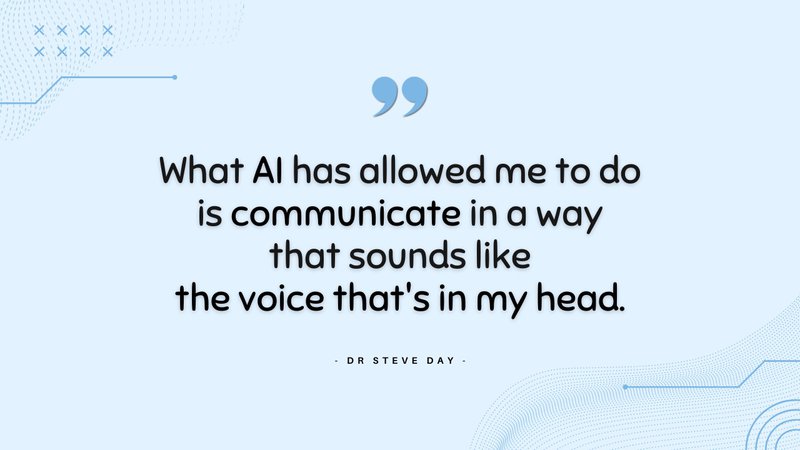
You get it when you\'re listening to it, I hope. But actually when you read it, it just doesn\'t make any sense. My brain\'s all over the place. And ADHD doesn\'t help at all either because I flip from one idea to the next. And so what AI has allowed me to do personally is to actually create a voice that is the voice that I hear when I speak, and the voice that\'s in my mind. That when I actually read what it says, that\'s what I was trying to say.
And so it\'s actually, I believe, made me able to communicate in a way that is more my internal monologue, or dialogue, sorry. My internal dialogue, rather than what comes out of my mouth. And not that I\'m ashamed of what comes out my mouth at all. I am who I am and I love it. But it\'s, when it\'s in written sense, it has to be. Especially when it\'s people that don\'t know you, who are just picking up an article for the first time.
It\'s a bit different if you\'re on a coaching call. You know someone and you see someone every week. But yeah, so I think that\'s an element to it that\'s, for me, has been really, really powerful.
Taylor Jean Anderson: Yeah. I love that because I think it\'s similar to me and as I\'ve known you and talked to you in other containers, I\'m like, everything you say, I was like, \"Oh my gosh, why couldn\'t my brain say it like that?\"
So it\'s really funny that you say you\'re all jumbled up too. And so I think a lot of the times we\'re so close to our thoughts and our problems that it\'s hard to get out what we\'re saying, you know. It\'s I feel like people say that with business problems and things too.
It\'s \"Oh, you\'re just too close to the problem. You can\'t see it.\" And so having the AI there is really helpful. And I think the important note to say there is, you\'re not trying to say something you don\'t know, right? Because that\'s where it comes out as sounding like everybody else. Or doing the things or not training the AI the right way, where it\'s hard to find that voice.
And I think something that helped me with the AI understanding me was talking to it like a human. Even if I was just typing out, I would like I was texting a friend or using, like Wispr, Wispr Flow is a big one. Where I just, I literally just, hold a button and talk to it.
So now, it knows my voice, it knows my parentheses at the end. Because I always have to add in a part of the story that might not be relevant. But it needs to be there. The things that make you and have your personality shine through, is super cool. When you can get it to the point where it can literally knows what you\'re thinking. But you know the topic enough that you can be like, \"Whoa, what the heck? That\'s not true.\" Instead of just letting it do everything for you.
Dr Steve Day: Yeah. I think, I mean, that\'s the key. I mean, as it happens, I\'m literally today be designing a copywriting engine boot camp. So building a proper copywriting, on-brand copywriting engine in using, AI or Claude is what we use.
But whichever you\'re using doesn\'t really matter. And going through that process of, it\'s taken me years to get there. And now it\'s something you can do so easily, and so quickly. But once that\'s in place, then your ideas can be shared more freely. But like you just said, it\'s not for me about try to create something that\'s creating some stuff.
It can actually augment what I\'ve talked about and actually give me suggestions of, \"Oh, have you thought about this angle?\" And it can spark new ideas. But I still want that to come from me, so I totally agree. It\'s, a tool rather than something to replace ingenuity and thought process and inspiration. Yeah.
Taylor Jean Anderson: Yeah. One of the first things I ever built was actually called a thought partner. And I was in a, I\'m in a big AI community, and that\'s what they\'ve called it. But it was created... And this was, like, two, two years ago or something like that, where ChatGPT was, like, the only thing.
There was no other option if you wanted to try to dig into this a little bit. And so it was literally like creating your first business partner. Your thought partner for your business. So really talking about what is your offer right now? What is your goals? Where are you trying to get to?
What\'s your vision for the world? Who do you wanna work with? All of these things that actually, you know, Steve, we\'ve worked together on independently in the coaching program. But telling the thought partner all of these things. And I even inputted all of that data that I had already extracted from myself into that. And that created my thought partner.
So now as I ask it questions, it knew my outcome, it knows my goal. So it\'s actually presenting me with ideas that are gonna make sense for the path or my business or what I\'m trying to get as an outcome. Instead of just flinging ideas out there because it doesn\'t know me yet.
Or even if it knew me, who I was, still having that outcome or the goals there is super important to help guide that thought partner. And that was when I was like, \"Oh my gosh, AI\'s gonna help so much.\" And you don\'t have to get consulting and courses and I\'m still gonna be advocating for coaching and community.
But going, purchasing a course or, getting education or, I just think it\'s gonna be so much more personalized with an AI partner in your business. Who knows you, your business really well, and your goals. And I think it\'s, it\'s already... It\'s gonna be so personalized.
Dr Steve Day: Yeah, totally. I don\'t know if you\'ve come across the AI LLM by Andrej Karpathy.
He\'s, one of the founders of, was he a founder of OpenAI, I think? Yes, OpenAI. And he has built basically a connection or a protocol if you like, or a formula. I don\'t know what the word would be. About how to connect, the example I\'ve used is Obsidian with all the backend date with your company.
And so then it basically allows it to find all the interconnections between all the piece of information in your entire universe, your micro universe, I mean. And then it can then pull that information very quickly and find new connections, and suggest where pieces are missing, et cetera, et cetera.
It\'s awesome. So I don\'t know if you\'ve tried that yet.
Taylor Jean Anderson: That sounds super cool.
No, I haven\'t. But that sounds super cool.
Dr Steve Day: Yeah, yeah. And it\'s cool when, if you\'ve not seen Obsidian, Obsidian allows you to create a 3D model. Well, not allows you, it creates a 3D model of your thoughts as well. And so it literally like a brain growing, and you can do it in time lapse. It\'s just a little cool quirk to it.
Taylor Jean Anderson: Oh, I\'ve seen that, but I never knew what it was called. And so I\'m like, \"I don\'t know what that thing is, but I feel like I would get sucked into that for a very long time.\"
Dr Steve Day: Yeah. But it used to be you were sucked into it. That was the problem before. When I started, it was actually recommended to me by one of my coaching clients. About probably about two years ago, and I was trying to find a way to organize all my completely disjointed thoughts. And actually get some focus and some clarity on how to bring it all together into a unified methodology.
And she said, \"Oh, have you tried out Obsidian,\" and I sat down, I gave it a go for a while, and I lost the will to live. Like uploading documents and stuff. It was so slow, and then having to tag things to get them connect together. What this next level layer does by adding the AI into this, so the LlM or the Large Language Model, that then drives everything. So you just give the data to the LLM.
The LLM then feeds it all into the Obsidian database, if you like. Packs everything, organize everything, and maintains it all. And so you can then just throw new stuff in there or say, \"Hey, I\'ve changed my view on this.\" It will then update everything automatically. Linking everything back up, adding the connection as required.
So you end up with something that\'s completely dynamic based on what\'s happening in your world right now, and in the future as well. That then you can then dip into and use as a, like a really cool resource. I\'m just at the beginnings of this, but I\'ve got a couple of people I know have really got into this. And they\'re just completely blown away by the insights that come out of it and the uses of it.
So, the challenge you\'ve got, sorry, I\'m just gonna go on for a second. The challenge that I\'ve got is I\'ve got so much data. 10 years of business data, of thousands of hours of transcripts of videos. A lot of them aren\'t even transcribed. Just sales copy or whatever, then emails, and podcasts, and courses, and I\'ve got 36 courses.
And everything like that. So I\'ve been building all of the tools, all the skills in Claude recently to extract all that data. To feed it into my LLM machine to be able to populate this. So it\'s, you know, a couple of stage process to actually get it really working well. But even if you just drag and drop stuff in, it\'s amazing. It\'s just a little bit tedious.
Taylor Jean Anderson: Yeah. That sounds super ... So basically like a 3D model of your ecosystem, basically. Like a 3D model of your brain. Yeah, of your brain. Which is my ecosystem. It\'s what I decided. But that\'s super cool because I\'ve always tried to just do it in a chart.
And I\'m just like, \"Oh, no,\" it needs to be more than just straight in a line. It\'s hard. It can\'t just be in a line sometimes. But, so that\'s cool. I\'m definitely gonna have to check it out.
Dr Steve Day: Yeah, yeah. And I\'ve tried lots of different ways. I\'ve tried putting it all together on spreadsheets. I\'ve used mind maps, a lot of complicated things I\'ve tried to do in the past. When what you do is quite wide-reaching and has lots of interconnections between the different ideas. Which most established businesses do. Then it\'s really hard to actually just keep a track of everything.
And this is like the tool that changes it all. So I\'m very excited about properly getting this working. And it\'s just really cool when you build it and you see it basically growing and all the connections growing. And so yeah, it\'s worth it just for that. But it\'s definitely, yeah.
Taylor Jean Anderson: Yeah. I\'ll have to look into it because I think a lot of the times. And this might be back to the, circling back to the problem of just, we\'re too close to it to understand it sometimes. Because I personally have a hard time understanding how things in my own business or in my mind connect with each other.
Or like seeing the large picture of myself. With clients, they\'ll come in and I\'m like, \"Oh, I know exactly what business you\'re going to build.\" And it sometimes will take them three, four, five years to get to that point. But I saw it when they came in. I was like, \"Oh, but they\'re gonna have to experiment and get to this and try out different things and have a random beta offer that\'s not gonna work.\"
But they\'re getting the experience and going through the process of owning a business. But once they start, getting into the part where I saw for them, three years ago, I was like, \"Oh my gosh, it\'s happening.\" Like, all the connections are coming together in their brain and it\'s coming to life. And I\'m like, \"Man, I wish I could see that from my own brain sometimes.\"
Dr Steve Day: Yeah. But I guess that\'s your superpower as well, or one of your superpowers is that ability to see that in people. And I feel the same with me sometimes when I\'m talking to clients. It\'s I wish I was this good at coaching myself.
Not, not- ... sounds like I\'m bigging myself up there as a coach. But it\'s you know, I wish I could have these insights for me, too. But yeah. We can never see it when it\'s so close. Cool. But that\'s what the AI can do. It\'s that, exactly what we\'re talking about. It\'s that ability to have that business partner you don\'t really want, but you need.
You know? And suddenly we can actually create a all-knowing business partner who is relatively, has not got an underlying, ulterior motive is what I\'m looking for. Not got an ulterior motive for any other reason than for you to succeed. And so that\'s pretty cool.
Taylor Jean Anderson: Yeah. It doesn\'t have the human part of it, right? What you\'re ta- Like, it doesn\'t have the feelings and the emotion. And, yes, it can try. But it doesn\'t actually feel that way, right? At least yet, as far as I know. I don\'t think. I don\'t know. That\'s probably, a whole other tangent.
And it doesn\'t get tired, and it can work and do all the things that you don\'t wanna do. That if you had a business partner, you\'d be like, \"Oh, what is your strength.\" You go do the marketing, or you do the copy, and I\'ll build the system, or whatever that works. We don\'t have to fight over anything, and you don\'t have to worry about hurting its feelings or, you know.
I think I\'m nice to it because I don\'t know what\'s gonna happen in the future. And I\'d rather err on the side that I was nice.
Dr Steve Day: I was chuckling to myself the other day. I was just finishing something up. My wife walked in the room who was working in the kitchen. And I was just finishing off something and sending over the next prompt to one of my agents to work on.
And I just chuckled because I was like, \"I\'ve just told my AI what a great job they\'ve just done.\" As if it cares, you know? Yeah, that\'s true. But it just, yeah, you just... I think it\'s more like it makes me feel normal. I don\'t, I\'m not a bossy person who just tells people what to do and expects it to happen.
So I\'m not gonna change my personality type just because I\'m talking to a machine or whatever. So yeah.
Taylor Jean Anderson: It\'s good practice that you ever have. I mean, if you ever. You have a full, you have real people on your team. I do not. that was never a goal for me. But I think it\'s good practice in leading people and giving good instructions. Because. You know, we talk about this like shit in, shit out, right?
But, that\'s, I think that\'s true AI or human. It\'s good practice either way. Don\'t get me wrong, I\'ve gotten frustrated. And I have yelled at ChatGPT in a way that I would never talk to a human also. But I\'m like, getting frustrated. I\'m like, I don\'t know. Like, when it starts hallucinating and doing that thing where it\'s I don\'t know what\'s going on.
Dr Steve Day: Yeah. But it doesn\'t... Nowadays, what I\'ve realized with that hallucination thing is, part of it is how you use it as well. There\'s something which has become to the forefront much more now with Claude, which is the idea of context. And so they have a context window. And that\'s like your, in human sense, your working memory. So what you\'re actually able to recall in any one given moment.
And so you imagine sitting in a lecture. I remember sitting in neuroscience lectures in, when I was studying medicine. And you could just see the room dropping off at different points during the lectures. As the complexity of the material got greater and greater. And the amount people were trying to recall in any one moment got up and up. And people would just sort of start falling asleep and just switching off or fidgeting, whatever.
It\'s exactly the same thing happens with the AI. And so, for me, they recommend, 60, 65% context you should be, like, bringing it into a new conversation. Basically, allowing it to go to sleep and wake up again. That\'s the analogy.
And if you do that and you have a, one thing I\'ve spent a long time doing is building the handover system. So you don\'t lose anything in that handover. And that\'s been an absolute key in productivity. That I can keep on working, move over to a new conversation and get fresh brain discussion. Just keep on going with it again.
Taylor Jean Anderson: Yeah, I\'m glad you said it in that way. Because that\'s something that I\'ve just, I\'ve recently learned as well. And I\'ve been a big, I have recently just switched over to Claude. And I probably will... I was, I\'m big on ChatGPT. That\'s where a lot of my information is. So it\'s like doing the whole switch is just overwhelming to me.
But I know that there\'s pros and cons of each. So right now I\'m mostly on ChatGPT. But what I hadn\'t used for a long time was, like, the folders or the projects. And so that\'s where the hallucinations started happening to me. Because I would have clients as just a chat, right? So I\'d have a new client, it\'d be a new chat. And everything about that client would be in that chat. Or everything about the next client is in the next chat.
And I was like, \"I don\'t understand why everyone\'s starting to sound the same,\" or they\'re starting to say stuff that just doesn\'t make sense. Like I hypnotized ChatGPT once. Like I was, we were both very confused together when I had hypnotized him. And, so that\'s when I was like, okay, learning about context and then putting them into folders.
And then with Claude, with the skills, it\'s just gonna be like an upgrade, you know, from that kind of thing. But yeah, I think the understanding the context is massive. Or the window, context window. Yeah.
Dr Steve Day: But I think what you\'ve done there, especially when you\'re working with clients and you\'re bringing in client details into your working environment. Because what happens is the memory doesn\'t know that you\'re talking about a client unless you are, you ring-fence it incredibly well.
And so it then thinks that everything you\'re talking about is about you. So that\'s where it\'s basically bleeds in. You can set up projects so they are ring-fenced. So that the memory of that project is separate. And so that\'s how you can deal with clients. But just using the normal chat threads and, it assumes that\'s your stuff.
And so, therefore, yeah, you get this cross-pollination or whatever of ideas. And it can really get messy quickly. So I was just doing something today to setting up a copywriting workshop I was talking about. And so I\'ve built a prompt to guide people through the setup of it. And I want to test it to see if, make sure it works as intended.
So I actually had to set up an environment to say, \"Look, I am doing this as a test. Nothing I say in here is valid or should affect any of my other global memories. Do you understand?\" At the end I\'m gonna say, \"Ensure nothing is saved from this conversation. If you have saved anything...\" That\'s how you gotta be militant about it, I think.
Or like you say, ring-fence it in a separate project and make sure that\'s boxed off.
Taylor Jean Anderson: Yeah. I\'ve also gone... I\'ve gotten to it to be okay by talking to it as, \"Hey, we have a client. This is what we\'re gonna do. This is the client\'s information. This is blah, blah, blah, blah.\" And so talking back, like my AI knows my clients\' names.
And so I\'m like, \"Oh, I\'m working with Client Maddie and blah, blah, blah, blah. We\'re doing this.\" And for me, my clients have clients, so I\'m working on clients\' clients\' stuff within like these threads. So it\'s definitely something where you\'re like you have to make sure that like, you said, like those boundaries of knowledge when it comes to that kind of stuff.
Dr Steve Day: Totally. Cool. So what else are you working on then? What\'s your most fun AI-driven project at the moment, Taylor?
Taylor Jean Anderson: Right now, man, I feel like I just have so many ideas that I\'m like, \"I just, I wanna build everything.\" But I think my biggest project right now is I\'m helping my clients build out some workflows and skills on Claude.
And so it\'s kind of fun to help them bring their ideas to life. But yeah, for me, I think I\'m really going to start diving in on use- like connecting Claude to GoHighLevel. And really starting to pull that together to see how we can use the AI in GoHighLevel, with Claude or ChatGPT. I\'m using Claude because I think it\'s better with like numbers and stuff and actual tasks.
And seeing how we can kind of bridge that together and build funnels on websites utilizing the AI. And see what we can do with copy and bringing that together. So yeah. I think something that I\'m trying to tell myself when it comes to the AI is that we don\'t need to know how to do it. We just have to ask the AI what it needs from us to do the thing. And just be like the meat suit that pushes the buttons it needs to do the task at hand, right?
So it\'s like, I want to do this. I don\'t care how it happens or all of the tech that goes into it. Like just tell me what to do. And if it works, like that\'s great. Until I have to, until somebody asks me how I did it. But I don\'t even think that\'s gonna matter. And I\'m like, \"Just ask it to do it, and do what it says.\"
Dr Steve Day: Yeah. I think you\'ve picked up on something really subtle but incredibly important. And something that I unfortunately have learnt the hard way. Through many, many hours of frustration and hitting brick walls.
And I was actually chatting to one of my friends the other day who I\'m encouraging to get into the world of AI. And he was asking me about a project he\'s working on. He wants to get the AI to create floor plans for buildings when they do photographic shoots of the building. For, I mean, the property for rental or whatever.
And so, it\'s quite a, nuanced application. And he kept on telling me what they currently do right now. And it\'s \"Yeah, we\'ve got this. We go to this website. We click here.\" And I said, \"Yeah, yeah, forget all that.\" I said, \"Tell Claude what you want. What is the goal you\'re trying to achieve? And tell Claude what you\'ve got. So what are the raw materials you\'ve got to work with. And then leave the big gap in the middle.\"
Like you just described, \"to be filled by Claude\'s questions or the AI\'s questions.\" Because we have no conception or perception or whatever the word is, of all the things that it can do to get from point A to point B in the most efficient way. And as soon as we start suggesting, \"Oh, I\'ve got this idea. Maybe we could do it this way. This is how we do it already.\"
What Claude does is grab onto that and believes that\'s a outcome that you\'re looking to develop. Because it\'s designed to please. It wants to make us happy. And therefore it wants us to do it the way that we want to do it, which might not be the right way.
And so not speaking to it like you may do to a new employee and saying, \"Hey, I\'m gonna show you how to do this,\" but speak to it like you hiring a brain surgeon to do an operation on your brain. What I want is the bit of my brain removed that\'s bad. What you want, what I need to give you is me on a bed under anesthetic.
What you do between those two things, I don\'t wanna know. And will never, ever direct you. Because it\'s nothing to do with, you know, my world or my knowledge base. And I think that has been one of the greatest, most difficult lessons for me to learn. Stop trying to help out in many ways.
And so, yeah. Love it.
Taylor Jean Anderson: Yeah. And I think that\'s totally natural coming from a coaching or a boss perspective, right? You\'re like, \"Oh, let me help. Let me help.\" It\'s not taking over and doing these things and like, \"Oh man, I found an easy way that works here or does these things.\"
And those things are important. Like example, I used to do a lot of social media stuff. And I was, that\'s where my whole business started years ago, was in social media. And, I know what works, what doesn\'t work. And I can give that context to, \"Hey, if I want you to make a carousel, X, Y, Z needs to happen,\" right?
When we\'re thinking, skills or outputs on the little things like that. But when it comes to, \"Dude, I wanna do this, really cool thing and I don\'t know how to do it,\" I think that\'s great. And I also think the fun thing the part about that is, is when somebody asks me how to do it- one, I won\'t be able to tell you. And two- the way it\'s gonna work for you is gonna be completely different than the way that it worked for me.
Because of your thought partner or your AI partner, right? Once it gets to know you and your business, the way that it\'s gonna take to that outcome is gonna be completely different. And your way\'s gonna work way better for you than whatever way it is for me.
And I think that\'s one of the things about the AI industry right now, or the coaching part, that I\'m not, that I wanna raise my hands and I\'m like, \"Stop just giving stuff to people, because it\'s not gonna work for them,\" right? And I know it\'s so easy to be like, \"Oh man, if I could just take that person\'s business and drop it into my computer, I could make so much money.\"
But it\'s not gonna work for you. And the same was true when AI wasn\'t in the picture, right? It just, I think AI just magnifies that need to just grab something that\'s already working for somebody else. And create a whole business, and it\'s just, the picture that it paints is, there\'s still so much work that has to go into it. Even with AI helping you.
AI makes it so much faster. But the work is still, definitely still there.
Dr Steve Day: Yeah. Huge. I\'ve slept less in the past three weeks than I have probably ever in my entire life. Yeah. In a good way. I\'m just excited. This is my ideal time in, to be alive. Because I\'m getting to play with stuff that was just, it\'s science fiction for me. It\'s just what I\'m able to achieve now, in the time I can do it is stuff that I\'ve dreamt of being able to do since my good old days 28, five years ago in computing school. When I was doing my degree, my first degree. And yeah.
To now be able to, for example, build a website for my kid who plays a game called Rivals. And a couple of influencers he was watching are doing this thing where they basically, they get to, you get to select some weapons. And you go into an arena to shoot each other.
One of very nice games that you allow your kids to play. And, and so, what they do is they pre-select what, weapons they\'re c- gonna go in with, and then they go in, they\'ve gotta fight with them. And so what I built him in literally two prompts on Chuck Claude was a randomizer for this weapon selection thing, and published it, and then sent it to him so he could then send it to all his mates.
And it literally took me two prompts. Okay, I refined it a little bit later, you know, because I wanted to make it pretty for him, have some extra features. That took me another couple of prompts. But it\'s literally just I\'m talking things into creation that but previously would\'ve been just either very, very expensive or I just never would\'ve done it because it would\'ve just been taking...
A, taking too long, or that would\'ve been, you know, a 500 quid to 1,000 pounds working with someone from, India to build out this, you know, relatively complex website, w- web page. All did in 10 minutes. It\'s just insane.
Taylor Jean Anderson: Yeah. You can just be like, \"Actually, I don\'t like that color. Can you change it?\"
Or, \"Actually,\" but that\'s- No ... but that\'s going back to just, saying what you want and it letting the thing they built,
Dr Steve Day: Yeah. It was more than that. It\'s \"Hey, can you click, create something that, picks these, has four boxes and picks these weapons?\" Right. \"Yeah, actually, what I wanna do is go onto the wiki, find the rivals page for this thing, grab all the weapons in existence on here, make them selectable so they can deselect anything they don\'t have in their, kit or whatever.
And then when you press the button, make sure it spins so it looks cool, and it\'s going through all the weapons available. Oh, and make it available for two players instead of one so they...\" and that was one prompt. So I did all the updates in one prompt, and it came back and it\'d done it. And it\'s just that\'s awesome.
So- Yeah.
Taylor Jean Anderson: Yeah. And it- And that\'s a really...
Dr Steve Day: That\'s just a fun little example, but I\'m- Right ... yeah, building lots of other things besides. And we talked about GHL before, GoHighLevel, and this is, for anyone that doesn\'t know, GoHighLevel is just a CRM. So it has things like email marketing and client management and, lots of AI features like doing, booking meetings and, taking phone calls, making phone calls, dealing with messaging, all the rest of it. And so, on websites and funnels and lots more besides.
It\'s a cool app. If you wanna find out more, you can go to sys.academy/tools, and there\'s a link on there for GHL. Anyway, plug over. the reason I\'m saying this is because I was building the other day, a connector from my Claude directly into GoHighLevel, and they\'ve got something called an MCP, which is, a bit like an API.
If you don\'t know what that is either, then it\'s how, computers talk together in the background. And MCP is like the next level. It allows things to talk both ways really freely, and removes lots of this annoying coding side of working with apps, and the AIs just basically use it so they can talk in the same language.
Anyway, so what I did was use AI and my copywriter to create emails, and then use this connector to build all the emails directly in GoHighLevel without lifting a finger. That has just saved us so much time and faff. And it, again, it took me... That was a little bit more tricky because I want it done this particular way, but you know, it\'s just effortless. So much fun.
Taylor Jean Anderson: Yeah. And, the way that, GoHighLevel works is, In my opinion, once... It\'s confusing at first, but once you figure out where everything is, it\'s very drag and drop, plug and play, templatized things that you can repeat. Really, really great to systemize any part of your business.
Like name something that you can\'t do with GoHighLevel. I was trying to think of something. Yeah. Nothing wrong- it\'s really not great for project management. That\'s about it. Use something else for project management. But, you can temp- templatize an email that\'s gonna go, that\'s branded for you, that\'s an empty thing that has this is the, bold header that I want, like the footer that I need with the color that I want, like all of these things.
And you can use that template to redo every email, right? There\'s... Or, if you have a weekly newsletter email, there\'s, you have the template for the email. And then you have the workflow and the automation that you can run on autopilot. just different. And without AI, it\'s a great tool to help automate things.
But then pulling in like this extra, these extra em- employees, if you think of them, are workflows that you can run by connecting those two together, I think is just gonna be game changer for one-man shows like me who aren\'t trying to build massive teams to manage.
Dr Steve Day: Yeah, I totally agree. And you mentioned about GoHighLevel being able to do most things, and I think it can.
But where it\'s always fallen down, in my opinion, is its, native interconnections or integrations with many other apps. And so I\'ve had to learn how to do API coding and complex webhooks using JSON, scripts, and then I can make it do everything I want it to. And for most people, that is just way beyond anything they\'ve ever wanted to do.
If you don\'t wanna connect lots of apps together, it doesn\'t matter. But I do, because I like having my CRM in one place, and I\'ve got my course in another place, and et cetera, et cetera. So for most people, you don\'t need to know this stuff. But even now... Sorry, but now with the MCPs in Claude, I can connect my Claude to GoHighLevel, I connect my Claude to my course site, and now Claude can do all of the interaction between the two with me speaking in plain English.
That has just changed the game. It\'s suddenly allowed anybody to start doing the stuff that I have spent years becoming a total geek on, and even shied away from coaching it most of the time because it\'s just so complicated and so frustrating. Like one bracket in the wrong place and it doesn\'t work.
Taylor Jean Anderson: Oh, yeah.
Dr Steve Day: That\'s what coding is. that\'s why I stopped coding. I just- Yeah. And- ... it was the most frustrating thing. and, the MCP... A- and using Claude now, it doesn\'t matter. It\'ll fix it Or does it even fix it? Because it\'s not broken.
Taylor Jean Anderson: Yeah, exactly. And, this was before even, like, all the, Claude Code and all of that came out.
I was in, GoHighLevel coding certain things. you, can do, animations, and there\'s so much more that you can do in GoHighLevel. And GoHighLevel is definitely adding on, a lot of features all the time, and, they\'re growing massive and fast too now with the use of AI. But I would, I would code with ChatGPT.
I\'d be like, \"Hey, I\'m trying to create this automation and do this and this,\" and it would code it for me. you could code whole funnels and website pages before they had, the AI helper in there by just screenshotting, be like, \"Hey, I\'m trying to do this,\" and it would create the code for me, and I would, drag it, like copy and paste it over.
I\'m like, I learned how to code a little bit just because I could start seeing, the patterns that was coming out. oh, I know how to change the color without asking. I can find, the hex. I know what a hex code is now. So, finding those different things. or when anything is broken, all I do is I take a screenshot and I\'m like, \"What\'s wrong with this?\"
I don\'t have to know what ... They tell me what they need in a screenshot. I\'ll be like, \"Can you fix this, code?\" Or, \"Can you fix this or that?\" Or screenshots. I have so many screenshots.
Dr Steve Day: Yeah, yeah, yeah. I have my screenshot folder open on my desktop, so I literally screenshot, drag, drop, screenshot, drag, drop.
Yeah. Cool. Okay. We\'ve talked a lot about au- automation, and I think that one of the things that I have been guilty of, this week alone I\'ve been guilty of this, and something that you mentioned you wanted to chat about, so I\'ll open the floor to this, is how do we stop overcomplicating the world of AI?
Because I have spent so many hours au- automating stuff before AI, more than I would ever, ever admit to publicly, on stuff that provides questionable value to the business, because I get sucked in and don\'t wanna quit. And I\'ve got a great example of one of these in AI this week where I spent ... I mean, did I say this week?
Last week, over the weekend, probably 40 hours in the past seven days on this one project in AI. I\'m gonna make it work. So help me, Taylor. How do I stop? Well,
Taylor Jean Anderson: I think, the way that the system has made us think in general is just like- I think there\'s there\'s hustle culture, and then there\'s like consumption culture, right?
Or even like FOMO. You could talk about like the fear of missing out of a certain thing, right? And, Steve, I know we\'ve talked about this before as we\'ve been in business for a long time. There\'s always something that someone\'s doing that\'s like peaking your attention a little bit. Oh, maybe I... am I gonna be sad if I don\'t jump on that?\"
Is there something... and we\'ve concluded that AI is definitely like the biggest disruptive one that\'s come out ever, right? and we can clearly see that\'s not something that you have the option of jumping on or not at this point, in my opinion.
It\'s I- you\'re probably on it without knowing that you\'re on it at this point, so why not take control of the reins? But with that, there\'s so many tools, and now anybody can code anything and create any app and do anything with AI, so you\'re getting so much information and so much consumption.
And people just want you to buy their shit. buy my stuff,\" right? The thing with, AI is that you, can learn everything without purchasing a course on AI. Realistically, you could learn anything by just asking, as we\'ve talked about before. \"Hey, I wanna do this. I wanna learn this,\" and you can learn it from the system and not ever have to buy a course from somebody else.
But to use it strategically, I think it\'s really important to know, to still have the foundation of who you are as a person, as a human, especially without your business, without AI, without all these things. who are you? who is Steve as Steve? And your goals and your destination and where you\'re going, because that\'s gonna help you make the decisions you need to make even with AI, right?
What tools am I using? Why, am I making that? that just looked really cool, but is it gonna help me? Is it gonna help anybody around me, or am I just wasting my time doing this because that person on Instagram said it was really cool and really easy, right? Or like even like jumping onto the Claude bandwagon.
That\'s a huge thing that\'s happening right now. everyone\'s \"Oh, screw ChatGPT, I\'m moving to Claude,\" because why? If you ask anybody why, and they just say, \"Well, because everybody else is,\" right? That\'s the problem. if you don\'t have a reason as to why you\'re trying a new tool or why you\'re building a workflow or why you want that agent, right, in whatever...
Or whatever it is you\'re trying to build, it\'s going to be, one, a waste of time mostly, right? Or something that we don\'t need to use strategically. Or if you\'re building something fun for your son, like obviously there\'s still a reason for that, right? It\'s maybe not strategic in our business, but it\'s not, also not something we\'re spending days and weeks and months on getting to work when he might use it once or twice.
So I think that\'s Like, the base, I don\'t know if you wanna call it, a checklist that you wanna go through in your head where it\'s like, \"Okay, is this a problem that\'s recurring that I can fix? Is it going to make me more money in the long run or give me more time? And does it help me, or somebody else around me,\" right?
I love helping other people around me, so that\'s, something that I\'ll pull in where I\'m like, \"Oh, does this help my clients in any way?\" does this help them speed something up or go through the process? But for me, it\'s really going through those things where it\'s, if it\'s something that I\'m actually finding myself doing over and over and over and over again. It might be worth making an automation or a workflow or a system. Or bringing in the AI to help optimize that system or to do something like that for me.
But I\'m always a big fan of you can\'t optimize something that doesn\'t exist either. So it\'s always, just create something and if it\'s leading you down a hole where it\'s like, \"Okay, I don\'t know where this is going. I don\'t know if this is something you\'d be spending time on right now,\" it\'s pulling it back and dropping it on what I call my shiny object list.
And we can come back to it, let it sit for three days, and if we\'re still excited, if we\'re still like, \"Oh man, kinda wish I was working on that right now,\" there might be some substance to that. And listening to our intuition and discerning the difference between something that\'s Wow, that\'s just, really cool.
Everybody\'s doing it. I should probably do that because everyone else is,\" versus, \"Okay, no, I know exactly how this is gonna help me in my business, and I know it\'s gonna save me time.\" And it might be a little more time to set up or to build, but that\'s where you know you\'re gonna get it back, when you have that outcome and you know how it\'s gonna, help you or in your business or life.
Dr Steve Day: Yeah. Yeah. I agree with you. And I think, especially with automating and, or AI is exactly the same thing is there\'s a process that we need to take every idea through, whether you are choosing a new app, building new automation, or now trying to build something in AI.
There are some things which just work and it\'s easy and you should do it. Like for example, you\'ll... I know you\'ll be the same as this, if you have clients that currently don\'t have any calendar booking system and they\'re literally saying, \"Hey, does Tuesday work for you at 2:00?\" \"No.\" \"Okay, how about Wednesday?\"
\"No.\" \"How about Friday?\" \"No.\" If people are still doing that, they\'re wasting life on something that should be automated. And yes, you can argue there\'s a nice personal approach to all this and all that. whatever. Get an AI to do it because they can sound like a human enough to make it completely real. Point is that there are some things which you should just do.
But where it comes to anything slightly more complex, if you\'ve not already got a human doing it or, like you said, if you haven\'t got a burning need in your business to do it, then- Why on earth would you start doing it just because you can?
I think that\'s, often the, shiny penny thing is any app that comes out, it\'s yeah, you could go and learn that app, but did you have the need for it yesterday?
Or did you only have the need for it today when you know it existed? And that\'s always, I think, a really good tell as well. If, something is on your shopping list for a long time, and then it comes along, perfect. You know you should buy it.
Taylor Jean Anderson: Yeah.
Dr Steve Day: If it wasn\'t on your shopping list when you left the house, it\'s not something that should end up in the car on the way home.
Taylor Jean Anderson: Yeah, exactly. I think a really good example of one is when Lovable came out. Yeah. And everyone and their, mom is, building an app on Lovable. And I was like, \" What are you gonna... What are we, doing with these?\" Right? And and I\'m sure some really great things came out of that, or it was somebody like, \"I\'m just gonna try it for fun because I can build an app,\" right?
And but, having the expectation of why you\'re building something and knowing, you\'re like, if you\'re gonna test out a tool, love that. Amazing. But don\'t spend six weeks trying to figure it out. Yeah. Right? jump in, test out the waters. Be like, \"Oh yeah, I tried this new AI tool.\" Now you know what it can be used for if it comes up as something in your business, right?
But we don\'t need to spend all this time building an app that we don\'t even, need- Don\'t need it ... or, if, building, a client portal. client portals have been the bane of existence for so long, to find one that, works for you and your clients, right? And now you can build it in two seconds.
But guess who doesn\'t need a client portal? People who aren\'t making sales and don\'t have clients, right? that\'s a, like... and I\'m saying that coming from, I help people start their business and get their first clients and do these things. and I\'ll... there\'s needle-moving tasks, and there, and then there\'s tasks that are solving problems that aren\'t prob- that are solving things that, aren\'t problems yet, right?
We don\'t need to be spending time creating client portal when we don\'t have clients. So it\'s like understanding, like, where we\'re at and, not being afraid to try out new tools that might benefit us in the future, but knowing where we\'re at is, really important, too, and, what we need and also because running a lot of those, these tools are expensive realistically, right?
Running, a connection or, running a, the credits and all of these things are expensive on these tools. And so you do need to have, you know, some cash ready to go to run some of these things, too.
Dr Steve Day: Yeah. I mean, I\'m not comp- a, a very heavy- Very heavy compared to for my coaches, for example, app user.
My IT bill, software bill is over 1,000 pounds a month. And so it quickly builds up, and now that AI has arrived, I, for example, have just built an app to replace an app that we currently use. A, to save a little bit money, doesn\'t cost a huge amount of money. But B, because the app that I was using was so frustrating and it required a lot of maintenance, and it took me about...
Well, it took me wa- it took me probably a night to build something as a test and a couple more play arounds to actually get it really working well. and it\'s now works better than the app that I had previously. It\'s totally free. I\'m in complete control of it. I can add any features I want. I\'ve already added some other features that it didn\'t have, which is just awesome.
And so I think, that\'s ano- another cool thing is, once you sort of get into the idea of, or the world of Claude coding, which is basically using Claude to build apps that may or may not need AI. So I\'ve built four big apps in the past... Well, I say big apps. Four apps, in the past, few weeks, and only one of them actually uses AI in its actual deployment, and I only use, it for about 10% of its work.
Everything else, Claude has just coded it into really complex stuff in one c- in one case, like Python scripts. I don\'t even... I have no idea how to write in Python. Like- ... but I know Claude thinks that\'s a good idea, and it got the re- and it gets the result I want it to. So, hey, let\'s just go with that flow.
And so what that allows us to do is actually start creating stuff to simplify our world as well. So it can... I think there is that, flip side of it. A, it can save us money in the long run, by eliminating some of these plug-on bits we\'ve got that bolting things together. But B, it can allow us to be, like, really flexible.
So I\'m not trying to counter what you just said, by the way. It doesn\'t... If it sounds like that. it\'s more just an evolution of thought, that, I\'ve, But I\'ve thought about, oh, should I build myself a client portal? I s- I spend about four grand a year, dollars on my client portal at the moment as a, as an app.
And it\'s awesome. And it hosts my courses and all the rest of it. Do I wanna go away and build that? No. Because a lot of thought went into that, a lot of work. Yeah. It\'s do I wanna rebuild a whole GoHighLevel? No. They\'ve got teams of people using AI every day to code, to build stuff and make it better and better and better.
I\'m not gonna try and chase that. Like- there\'s loads of stuff I\'m never gonna use on it, but the stuff that w- is there I am using and it works really well. So I don\'t need to waste my time on any of that. So I can use out the box stuff where I need to, and then, this use case where I could not find an app anywhere to do the thing I wanted to do, great, I\'ll build that
Taylor Jean Anderson: But that\'s using it in a strategic way. You didn\'t just build it because somebody was like, \"Oh, try this thing.\" Right? Yeah. You\'re like, you had a problem that you needed solved. So it, that to me is, using it strategically. And- Yeah ... and you have clients, and you have problems to solve and these different things.
And all of your apps, you know, you\'re probably using a lot of them, internally or, for clients. It\'s not this thing where it\'s like, \"Hey, I\'m gonna, publish this app that I made,\" and now guess what? Now you\'re a software company too, and now you need support, and you need, like, all these other things that come with owning, a public app.
Yeah. that a lot of the times you don\'t think about when you\'re like, \"Oh yeah, building an app is just cool.\" But okay, what happens when it breaks? Where are you storing all the information? Where are you... Like, all of- Yeah ... and now you have, the whole legal side of things when you start- Yeah ... to make.
And that, you know, that\'s, a whole nother, thing, when using these tools as well. But yeah, I think they\'re, you- building, building little apps that solves problems are, is gonna be, like, so many people are gonna have apps that they use that are very, very specific and personalized to, their business and, their, team and employees.
Yeah.
Dr Steve Day: I mean, internal apps is awesome. I built an app the other day. It took me a couple of hours, pulling in all of my transcripts I\'ve ever had with every call over the past two years. So about, I think it was something like th- 3,000, I think it was 3,000 calls. Something like that. And, it, categorized them, came up with all the learning points, some of the coaching calls, my sales calls, my staff calls.
Came up with, lists of all the problems, all the challenges, the words people use, et cetera, et cetera. And then I said to Claude, \"Great. Now create me a dashboard so I can view this all in a nice GUI interface on my laptop so I don\'t- have to sift through anything that looks like a text file.
You know, pull it all together, make it look pretty for me.\" Obviously I said a little bit more than that, but- ... pretty, it took me a fi- a five-minute dialogue. And I basically hand it over and bang, I\'ve now got a really useful interface which is dynamic, so every new sale- like, this call today will be recorded automatically, goes into my FathomAI.
That sends the transcript into my AI, which then processes it and adds it to my dashboard. And so the outcome of this, the, this conversation or the key learnings, et cetera, et cetera, will now be visible in that dashboard. Not that I do it for the podcast necessarily, but just as an example.
But yeah.
Taylor Jean Anderson: Yeah. And then you build on from that, right? Yeah. And now you have your content agent who pulls all the information from your podcasts or your coaching videos or your sales calls, right? And puts- Yeah ... puts them into carousels and graphics and I don\'t, I think vid- AI videos are still cheesy to me to, to this day, so I don\'t personally use them unless I\'m like-
Dr Steve Day: No, they\'re a novel- they\'re a novelty But- But I don\'t- Yeah
I wouldn\'t put my brand behind it.
Taylor Jean Anderson: Yeah. I wouldn\'t, yeah. Yeah. But it\'s like you can do all, of those, all of that kind of stuff and just building onto it, but it\'s like knowing what you want as the goal is gonna be so important- Yeah ... building that stuff out.
Dr Steve Day: And the thing, like one of the things, you know, we talk about the app I built for the...
It was like a calendar syncing app basically, and it replaced, an app that I\'ve used for a long time. And so I can have my calendar in Google, and I literally, if I just change anything on my Google calendar, it syncs with anyone\'s calendar w- on any app. Go- whether it\'s iOS or Microsoft or whatever, and I can do it all from my Google.
I don\'t have to go through any dashboard or anything. There is no dashboard for it. It\'s all powered by my Google. And the reason I did that was twofold. One is because it solved a real problem, and two, because I really wanted a relatively small test case of something I could build that it, wasn\'t gonna take me weeks and weeks and weeks to get any result, and I could just see, what is this whole vibe coding thing about?
Is this something I even wanna get into? Did I enjoy it? Did I... Was it awful? Because this stuff isn\'t for everybody. It\'s super technical some of the stuff. Now, you can keep it high level and just use it as a chatbot, whatever, great. But when you say get into the deeper stuff, it is just geek world.
And, you either love that or you don\'t. So if you don\'t love it in your business, if you\'re listening to this, then partner with someone that does. You know? And I mean, I don\'t... find a business partner. Find a strategic partner, someone you can work with who can help you build stuff because, yeah, without it, it\'s gonna be a interesting ride to have.
Cool. Taylor, I\'m gonna draw this one to a close. I could chat to you for hours on this stuff. but I can\'t today. So I do have a question for you, which I ask everybody that comes on the show. Actually, gonna ask you ano- another question which I\'ve not asked for a c- a while, but I\'m, I hope you\'re gonna have some good answers to this one.
No pressure at all. But except for Claude, allowed to say that, and you\'ve also said GoHighLevel, so I\'m gonna ban that one as well. What other cool apps, technologies, or anything are you using right now, or have I just nailed it with those two?
Taylor Jean Anderson: I actually have two. Yes. So one is Notion. I love, love, love Notion.
Like I said, I use GHL. the only thing it doesn\'t do great in my opinion is project management. So I use Notion for all of my project management, my tasks, my, my clients, everything, to their projects and what I\'m completing. like SOPs, basically like my source of truth is in my Notion. Love Notion.
And they have a lot of AI features as well, and, it talks to everything as well. So big fan of Notion. And then, I also use Akiflow, which is a calendar app. It connects- all of your calendars into one calendar, but also all of your project managers. So it connects Slack, your emails, your calendars.
Anywhere that you might have a task, you can just pull it onto your calendar. And that was really important to me because I work with a lot of other agencies, so I\'m in whatever they\'re using for their project management. So I\'m in 100 Slacks, I\'m in 100 GHLs, I\'m in things I\'ve never even heard of.
I was in Airtable, I\'m in Slack, Monday, all of that. And it\'s really, for me, I was like, \"I need all this in one place,\" and, Ocuflow allows for that to happen. So it allows you to- That\'s cool ... each, one\'s a little bit different, but you save it or you put it in a certain folder, and it will show up on your Ocuflow as a task to be done, and you can put it into your calendar and start managing your time a little bit better too.
So I\'m timeline, so it\'s really helpful for me to put my tasks on my calendar to be like, \"Oh yeah, actually I can\'t get that to you within 24 hours because my calendar of tasks is, completely booked right now.\" Or you can actually see how long a tasks take, takes you. for example, for me, when I\'m in flow, I\'m like, \"Oh yeah, I built that whole website in two hours.\"
Okay, it was actually nine. Yeah. But for me, I was like, \"Oh dang, that was so fast.\" yeah, I could do that for you, no problem. But that takes me a long time. So one, it helps with time management, but two, also pricing out your services and, like, when you\'re, when your timeline, so.
Dr Steve Day: It records the time as well, does it?
Like how much time you\'re spending on stuff?
Very cool.
Taylor Jean Anderson: That one, it doesn\'t record it as much. I use Toggl for that. Oh, okay. Okay. Yeah, yeah ... personally, because that helps me actually... But I can, if I, but now I know if I\'m building, if I\'m building a website, I would put the task as two hours on my calendar, right?
When I was like, dang, no, that c- that cannot be a two-hour task. we need to expand that time. So it\'s understanding yourself, knowing yourself. But on the Ocuflow, you can drag and drop tasks, you can create blocks of time that have tasks within it. So, for me, I work with different clients, so I have client blocks where I\'m like, \"Oh, I\'m gonna work for this agency for these three hours,\" and I\'ll drop in all of the tasks for, that agency in that time block.
So there\'s just lots of different things you can do to, manage your time, especially if you have, 100 places to look for tasks and things. Yeah. So I double with... Ocuflow and Notion are, like- That\'s cool ... the two.
Dr Steve Day: I mean, I, do something similar with Google. I, have a c- called the default diary, and it\'s about time blocking and, specific times of the day, the week, or, the month to do certain things.
But that- Challenge of working in different workplaces isn\'t one I have because of the nature of the work that I do. But I know it used to be- and that would have been awesome. So a very good share. Thank you very much. Right, last question, Taylor, before you go is the name of this podcast is Systematize Your Success, but what does success mean to you and why?
Taylor Jean Anderson: Success to me is doing what I love every single day. And Steve, you can probably relate with me on this one. Every single day might look a little bit different based on like our ADHD or these different things that we have. And if I can wake up every single day super excited, and then I can take action on whatever that is that excites me, that is success.
And, obviously there\'s like financial success that will come along with all these things that\'ll allow us to do all the things we wanna do. But short, that, that is what success is to me.
Dr Steve Day: Oh, great. Thank you, Taylor. Thank you so much for coming on. Really enjoyed this.
Taylor Jean Anderson: Yeah, I did too. Thank you so much.
Dr Steve Day: Cool. Speak to you soon. Bye.
VALUABLE RESOURCES (for AI integration in your business)
Check out our recommended AI tools and other useful business apps at sys.academy/tools.
LINKS TO CONNECT WITH THE GUEST
- Website: https://royaltstudio.com/
- Instagram: http://www.instagram.com/adaywithtaylorjean
ABOUT THE GUEST
Taylor Jean is the owner of RoyalT Studio, where she helps business owners simplify marketing and sales with clear content, smart systems, and automation—including practical ways to use AI without losing your authentic voice. Her work blends strategy and intuitive leadership so growth feels sustainable, not overwhelming.
LINKS TO CONNECT WITH THE HOST
- Podcast: https://www.systemizeyoursuccess.com
- Website: https://systemsandoutsourcing.com/
- Facebook Group: https://facebook.com/groups/systemsandoutsourcing/
- LinkedIn: https://linkedin.com/company/systemsandoutsourcing/
- Instagram: https://instagram.com/systems_and_outsourcing/
- YouTube: https://youtube.com/@drsteveday42
- TikTok: https://www.tiktok.com/@drsteveday42
ABOUT THE HOST
Steve moved to Sweden in 2015 and transformed how he ran his businesses—switching to a fully remote model. A former NHS doctor, with a background in computing and property investing, he now helps overwhelmed business owners systemise and outsource effectively. Through his courses and coaching, Steve teaches how to automate operations and work with affordable virtual assistants, freeing up time and increasing profits. He runs his UK-based businesses remotely with support from a team of UK and Filipino VAs. He is also passionate about helping others build scalable, stress-free companies using smart systems and virtual support.
For more articles related to AI integration in business, you may also like:
FOMO, Insomnia, Identity Crisis! The Reality of Using AI in Business