
Your AI coding agents can build almost anything. But will those workflows still perform at their best when today’s leading AI model becomes yesterday’s news?
I spent my first year building with AI inside OpenAI.
I haven't opened it in eight months.
Everything I made in there is still sitting exactly where I left it.
Not deleted. Just doing nothing.
You might have your own version of that.
Prompts, agents, whole chunks of process, all built inside whichever tool everybody was using the month you started.
Then a better one turns up. And you move.
That's what started nagging at me.
Not the moving. The fact that the work was welded to the tool in the first place.
I got into it this week with Emilie Schario, who ran product and engineering at Kilo, an open-source AI coding platform, right up to Anaconda buying it.
Her line for it stuck with me.
Models change. Good workflows don't.
So Kilo keeps the workflow yours and the model swappable.
Whatever turns out to be best next year, you point at that instead of starting again.
And it turns out most jobs don't want the cleverest model anyway.
Using the top one for everything, she said, is like hiring a maths genius to put together your P&L.
There's a better way to decide which one does what, and it isn't you sitting there choosing from a list of 500.
Then we got onto the part I wasn't expecting.
Because once building gets this cheap, the hard bit stops being whether you can.
The hard bit is saying no.
When AI first turned up, I barely slept for three weeks.
Laptop at the kitchen table through dinner, answering its questions so it wouldn't sit idle.
Years of training myself out of chasing shiny pennies, undone in under a month.
Emilie's test for that is blunt, and I liked it.
Sometimes you pay the ten dollars a month and let someone else maintain the thing.
Mine is a score every project has to pass before I'm allowed to start it.
AI projects get no exemption. Most don't pass.
Have a listen – it might save you rebuilding all of this in two years' time.
KEY TAKEAWAYS: AI Coding Agents Lessons for Sustainable Workflows
- Future-Proof Your AI Workflows by Staying Model-Agnostic: Building all your AI solutions inside a single model ecosystem is risky – what's hot today could be obsolete tomorrow. Instead, focus on tools and platforms that let you switch models as tech evolves, so your workflows remain relevant, and your investments aren't lost.
- Tame AI Overwhelm with Smart Project Management: It's easy to get swept up in the excitement of new AI tools and end up juggling too many projects. Set strict criteria – like my 20/20 project vision board – before starting anything new, and be disciplined about not just starting projects because you can. This keeps your focus (and sanity!) intact as you grow.
- Delegate to AI the Same Way You Would to a Human: Before automating a workflow or handing tasks to an AI agent, break down the process just like you’d train a new employee or VA. Define the steps, inputs, outputs, and checkpoints – then let your AI learn and improve over time. That’s how you get reliable outcomes instead of constant troubleshooting.
BEST MOMENTS: Insights on Using AI Coding Agents in Business
04:56 – 💬 “Models change, great workflows don't.” – Emilie Schario
06:31 – 💬 “This is more than just some clever assistant. This is totally going to revolutionise the way that I work, my clients work, the way I work for my clients, and the world beyond that.” – Steve Day
10:22 – 💬 “Be really clear on what the problem you're trying to solve, not just what's the right tool.” – Emilie Schario
23:12 – 💬 “Just because I can, it's not the reason I should…if it doesn't score 20 out of 20 on my project vision board, it doesn't happen.” – Steve Day
30:03 – 💬 “Human delegation is almost identical to AI delegation.” – Steve Day
34:08 – 💬 “The best thing you can do when you're thinking about managing your AI spend isn't don't use AI. You're using it because you're seeing efficiency gains from it. It's making sure you're using the right tool for the task, or in this case, the right model for the task and getting the best bang for your buck.” – Emilie Schario
TIMESTAMPED OVERVIEW
00:00 Intro: Choosing The Right AI Tools
06:17 Discovering Code and AI Potential
09:01 Choosing the right digital tool
13:19 Automating business with a cloud server
14:08 Overwhelmed by multiple projects
17:18 Software solving temporary problems
23:26 Creating a project vision system
27:57 Delegating tasks to AI and VAs
32:24 Introducing Kilo's project integration
Episode Transcript
Please note: This transcript was generated using automated transcription tools and may contain typographical errors or inaccurately captured words or phrases.
Dr Steve Day: One of the things that worries me about AI is the fact that if I build everything in one technology, say Claude or OpenAI, and then things change in the future, like what happens to all the stuff I\'ve built? Does it mean that I end up with lots of stuff on different platforms? That problem, that challenge, or that worry took me to research some possible solutions. And one of those is an app called Kilo.ai or Kilo.
It\'s an open source app, and it\'s actually free to use for individual users. And today, I interviewed the co-founder of Kilo, who\'s now vice president of Anaconda, the people that took over Kilo. To find out a bit more about what is Kilo all about. Why should we as small business owners be considering using it rather than just jumping in and using, say, Claude or whatever the flavor of the day is? And how can we future-proof our business AI technologies and also massively reduce costs by using an app such as Kilo?
This is definitely an episode for you if you are getting into building stuff with AI or using AI as part of your workforce. If you are, then you\'ll be aware of some of the potential challenges of moving from one AI agent to the other. And also the escalating costs of the using of tokens within AI agents.
Kilo is an app that\'s designed to solve both of those problems from day one. Hope you enjoy this interview as much as I did recording it. Thanks.
Emilie, thank you so much for coming on the show. I\'m excited to have a chat with you about Kilo, about the software that you work with. And, before we get into that and what that all is, tell us a bit about you. Why do you, why did you start this project in the first place? Why Kilo, maybe very quick what Kilo is? And, yeah, why is your passion in this, and why do you continue to work on it to this day?
Emilie Schario: Thanks so much. Nothing like a, a nice little warm-up question to get started, right? Jump right in. So Emilie Schario, based out of just outside Atlanta, Georgia. And Kilo is an agentic engineering platform. So when I joined Kilo, the project already existed. I led product and engineering until our acquisition by Anaconda quite recently.
And the thing that I love about Kilo really traces back to when I had my, \"Oh my God, AI is gonna change everything\" moment, back in late 2024. I mean, I had the ChatGPT moment that everyone did. But ChatGPT and tools like it are really good at just spitting out text. And text is cool. But there\'s so much more that we can do now with tools like Kilo.
And so what I started, my moment came from experimenting with a tool called Bolt, bolt.new, where I could build apps. And so I remember kind of saying, \"Build a to-do app,\" everyone\'s favorite demo example, right? \"Build a to-do app,\" and it spit something out. And then I said, \"Make it blue,\" and it changed the whole thing to blue in the same amount of time that it took me to type the sentence, \"Make it blue.\" And I remember just turning to my coworkers and saying, \"Oh, my God, I\'ve seen the future. This is gonna be amazing.\"
So, I trace back my really becoming AI pilled to that fall 2024 window. And then I joined Kilo in fall 2025. And what separates Kilo from a lot of the other tools on the market is that, we are model agnostic.
So when you\'re using Codex, you\'re in the OpenAI, ecosystem. You\'re only using their models. Or when you\'re using Claude, you\'re in the Anthropic ecosystem. And there are some other similar tools. But what they\'re doing is they\'re marrying the software you\'re using to the models. Anyone who\'s paying close attention will tell you that the best models are changing every day.
And so, we wanna make it so you can have your workflows and the best model or the model changing doesn\'t require your workflow to change. Not only that, but every task doesn\'t require the best model. That\'s not the best bang for your buck, right? It\'s like hiring a super math genius to put together your P&L, right? That\'s not the best use of your business dollars.
And so, we frame it as great workflows- models change, great workflows don\'t. And so how do you find yourself set up with a system and a tool that\'s gonna be there independent of the model that\'s trendy in that day. So at Kilo, we work with companies and individuals of all shapes and sizes across the world. Really helping them kinda solve whatever the sort of problems are where coding can be a piece of that solution.
Dr Steve Day: Cool. That was very, very concise but very clear summary. So thank you for that. I- just before we came on I was explaining why I wanted to speak to you on this show. And I pick people that I have a genuine interest in the subject you\'re talking about. And so for me, the reason I wanted to chat to you today about Kilo is because I\'m in that basket which you just described.
So I\'m using Claude to do my AI. Like, I did use ChatGPT and when I was in the chatting part of my AI development and I was just using it really to ask it questions. Or maybe get it to process a document and wasn\'t really getting into the agentic workflow scenarios. And then I- Claude sort of came into my awareness, and I then started using VS Code to get into the CLI. So the backend version of Claude. And that\'s when everything changed for me.
And suddenly I was like, a bit like you, that was the moment for me was this is more than just some clever assistant. This is totally going to revolutionize the way that I work, my clients work, the way I work for my clients, and the world beyond that. And so- but I\'ve also found massive challenges in that. So just to really, for anyone listening, if you\'re listening to this and you\'re using, say for example, Claude the chat or OpenAI chat, then that\'s a very different to what we\'re talking about here.
So what we\'re talking- what I\'m talking about anyway is I wanna build stuff with AI, and the end result may or may not use AI in its, in the way it works. And so I\'ve got examples of little apps I\'ve built that are just purely AI builds them, they run. It cost me nothing to run them. And I\'ve got other apps which combine AI with something I\'ve built.
And this is me being self-taught over the past eight months or so. But, and this is where I really wanna get into, just give you the background of where my intrigue came from when Kilo came onto my radar. Was that some of the challenges I\'ve had are keeping track of everything I\'m working on.
I can be spinning off a number of different projects at any one time. And just natively the way the Claude Code works is really not- well, it probably has developed a bit since I started, but it\'s not easy to use. It\'s not like, \"Hey, I can see exactly what\'s going on, where it\'s going on.\" And it seems to take a lot of planning from my side. It has taken, I should say, a lot of work to be able to build within my environment a setup which keeps track of different projects, where they\'re up to. That I can understand the different projects I\'m working on. I can see where they\'re up to, and I can actually coordinate things together easily.
And I what I\'m working towards is does Kilo help with that initial getting your head around how to manage the work within the backend, the CLI interface into Claude or whatever. Sorry, I keep saying Claude, but, AI agents. And if so, how? And how would that- if I started again today from scratch or I transitioned into Kilo, what would be different about my experience to my very clunky work-it-out-as-you-go, watch YouTube videos, figure something out, that sort of approach?
Emilie Schario: Yeah. I would, actually say where you probably want to start before exploring a new tool like Kilo is actually zooming out and saying, is the right tool for the task you\'re talking about solving a, like something that\'s coding on your machine?
And so, if you\'re- you didn\'t get into specifics around what you\'re building, but- and I\'m happy to if you want. But, one of the alternatives I\'d point you to is maybe you do want something like a Lovable or a Bolt.new instead. Because then you\'re not worried about environments, managing different versions of packages, and you can keep your machine clean.
Because that\'s one of the things that I think really stumbles, really creates a stumble for folks. Is they see these errors around packages, versions, incompatibilities, and they\'re wondering, \"Did I just put a vulnerability on my computer, and now I might have risked my whole machine?\" And so where you can, you actually might not want a tool like Kilo or Claude if it\'s not necessarily working with files on your computer. You might want something on the cloud that\'s kind of an app builder-like product.
So that\'s kind of one path. The other is being really clear on what the problem you\'re trying to solve. Not just what\'s the right tool, but what\'s the problem you\'re trying to solve. So I\'ll give you a really specific example, that I think is- you\'re probably gonna have something similar you can reference.
So I am a loyal Todoist user. Going on probably 10 years now of Todoist as my daily driver when it comes to making sure things get done. Life gets busy. Sometimes I fall behind. I catch back up. Todoist is an old, reliable piece of software for me. And I love and adore it.
I\'m also quite ambitious. Which means sometimes I will set up these big plans in Todoist for I\'m gonna read like a chapter of this really hard book a day. And then life happens and I can\'t get to it. And so as I had my coding agent build a script that takes the reading project, looks at the books, the chapters that are in it. And if I did not read yesterday\'s chapter, it just reschedules it to today and it pushes everything out.
So I\'m not staring at this wall of overdue tasks. And it happens overnight, so by the time I wake up in the morning, it\'s done. And this is a script that just runs on a schedule every day. It\'s in GitHub actions. You could run it on your machine. There\'s lots of options for this. But this is not like an AI task.
I had Kilo, the coding agent, write this script for me. It works reliably. I\'ve actually never even had to look at the code because it just works. And that\'s the exact sort of thing that I think you find these paper cut opportunities in your day. And so that\'s a shallow example, but you can think about how it applies to dealing with lots of things.
But you find these paper cut opportunities and you think about, like, how can I solve it? And then the AI can be a tool to solve that workflow. And now I don\'t revisit that unless, something breaks, the API changes. But I haven\'t had that happen yet, and it\'s been running for a year.
Dr Steve Day: Yeah, cool. And so I\'ve done very similar things. So I\'ve- for example, I had a calendar scheduling app which I use for my clients. And it was good, but it broke. It was slow to sync, and it was clunky to maintain. And so I took it- it\'s like this is more of a paper cut, this is more of a for a bad analogy, but getting a kitchen knife. And so I actually looked at it and tried to fix it through a simple approach and couldn\'t.
So I basically got AI to take it one step further and write an entire program that does it far better- far more integrated into my existing workflows. And again, I just, I run that on a VPS, a virtual private server in the cloud. So it doesn\'t, my computer doesn\'t need to be on. It\'s done 24/7.
And I\'m basically replacing a key problem that I had in my business that was dragging on my staff\'s time and just annoying for my clients when it didn\'t work. And create something that\'s far more personal for my business. Integrated into my existing workflows and onboarding, et cetera, and solves a real life problem. And that I felt was a cool thing to get sort of my under my belt, and that was when, for me, things really changed.
It\'s like you said, creating something that\'s like it solves a problem that you genuinely have. It\'s not just going out and creating something for the sake of it. And doing so in a way that you\'re like, \"I never have to think about that again.\" Or if I do, I\'ll call all that or my AI I\'ve wrote to fix it for me. But this, and going back to my original point, was like what I ended up doing there was like, that was one app that I created, and then I created something else, then I created something else.
And now I\'ve got all this stuff going on. I might wanna develop that a bit more in the future and develop this a bit more. So it\'s like going from that, what you\'ve just described, of like creating that first thing to fix something, I then quickly became completely overwhelmed. Because I saw the opportunity, got super excited, and tried to build everything.
And then it was, like, trying to manage all these different projects through basically, VS Code. For anyone that doesn\'t understand what that is, it\'s just like a text-based window on your computer. There\'s no pretty drag and drop. There\'s no windows like you experience in a typical, normal PC or Mac.
It\'s like going, it feels like you\'re going back 20, 30 years- when you actually look at it. And that\'s why I think- I\'m a visual person, so it also became quite challenging just to- in my own mind visualize what the hell I\'m actually working on, and where I\'m up to with stuff.
Emilie Schario: And Steve, have you built anything that you ended up sunsetting? Like, you build it, it served a purpose, and you\'re like, \"I\'m actually not gonna work on this anymore. Let me, either save it or archive it. Throw it away.\"
Dr Steve Day: Yeah, loads of stuff. Or stuff that I, yeah, I\'ve started and thought, \"Actually, I\'m just getting excited. This is shiny penny stuff. I need to come back to this later.\"
And so I\'ve spent a long time integrating my AI setup into my Asana. And so, I\'ve actually created my own agent track or a project tracking system, but all integrated the API into Asana. So again, that was another big challenge to create that. And it just seems like I\'m just having to fix loads of stuff that everybody must be going through.
We must all have these overwhelm problems. And I\'m guessing, like having looked at the stuff that Kilo does, it\'s like some of these things have been fixed by somebody else. And if I\'d known that in the beginning, then it may have saved me many, many, many hours. And that\'s really what I\'m, trying to explore. Yeah.
Emilie Schario: Yeah. I\'m really fascinated by this idea of what I\'m calling selfie-ware. Like software we build for us. It\'s not like you build it because you\'re gonna sell it or share it or anything like that. And so, there is this hair, a trichologist, which is like a hair care person, I don\'t know the specifics of it. But who I follow on social media who has like a hair care method called the Abbey Yung Method, and I think it\'s got 20 steps in it. And so when I first started getting into it, 20 steps while you\'re in the shower is a lot of steps to keep track of.
So I built an app that made it easier for me to follow what do I need when I\'m in the shower. And what tools do I need and what, which bond repair treatment and blah, blah, blah, blah, blah. And then after doing it regularly for, call it six weeks, I realized oh, I just know the routine now. Like I don\'t need this app anymore.
And so I think this like idea that we can build software to solve a problem, even if it\'s not a forever problem. Like the calculus of how easy it is to build a solution is completely different than it was just a year and a half ago. And so we can now, especially with the models constantly getting better, over the last year we see a material improvement in the models. And what you can do with them, what you can do with them without a person in the loop is just like fundamentally different than a year or a year and a half ago.
So being able to build something, have it serve a purpose for a month, two weeks even, and then being able to say, \"Okay, this is done,\" is something you can do in a way that wasn\'t true, just a year ago.
Dr Steve Day: Yeah. I\'ll give you a fun example for that is my son was playing a game called Rivals on Roblox every day and, maybe I shouldn\'t admit that as a parent, but there you go. Or every time he could, I should say. And he followed some people on YouTube, who were also pro players or whatever. And they had this way of them basically select, or having a tool select what weapons they were gonna use. Really simple thing.
So I just literally sat there with him. And I wanted to show him, get him into AI a little bit as well. And we literally in half an hour spun up a self-served app. So in the cloud app- through GitHub, that basically, all nicely designed, all graphics on there. It was like, really cool. It had animations, everything, just to solve this problem. He doesn\'t play that game anymore. It\'s totally irrelevant. But right then it was- he was the coolest- or that I was the coolest dad in the world, I should put it that way. Just for that day.
And so yeah, exactly. And you can put that into any business context as well. Like some of the stuff that was on the back burner for me now, or for years, I should say. It\'s like, I could do that now. Like, it\'s just- it suddenly changed the landscape of all the things that annoyed me about apps. And having a long-term background in computing, but it was many years ago.
But one of the things I got so frustrated about the world of computing was how complex it was to do anything. And how many people were involved, and how much coordination and project management and people management just to get the simplest things built. How much it cost. Like, all these things, were so frustrating as a small business owner, who was, who loved technology. And that\'s why I loved automation when I got into that, and that\'s why I love AI because it\'s I can do this.
Like yes, I could speed things up if I had a big development team helping me as well. And I\'ve got clients that do that. But for myself, it\'s like, this can be fun now, so.
Emilie Schario: Yeah. Don\'t you think the discipline challenge is different now? Like, it\'s a different kind of challenge to say no to all the fun ideas that come your way.
Dr Steve Day: Yeah. Absolutely. I mean, as someone with ADHD, or an ADHD brain, that is a challenge to me on a daily basis anyway. So I\'ve spent many years trying to condition myself not to chase shiny pennies. And that was the massive problem when it first came out. Is I literally, I didn\'t sleep for about three weeks, if not a lot, probably a lot longer than that. Didn\'t sleep very much at all, I should say.
And I was like, I turned from this person who had conditioned themselves to actually be really good and disciplined to back to square one. I was like, had my laptop at the kitchen table when I was having dinner, because I was answering questions for the AI so it could keep on going.
Because it\'s like this massive FOMO or just not wanting to lose a minute. Because it was just working so fast on these problems. And I got sucked into it, and I had to go, \"Hold on a minute.\" This is actually not the life that I choose to live. So yeah. Very much so.
Emilie Schario: What do you think is the hardest part of that change in discipline? Like, I\'m seeing people say, \"Well, now we can just build everything.\" And I remind them, \"Maybe it\'s better for you to just pay the $10 a month for the off-the-shelf software, rather than you build this one time and actually have to maintain it every week. You\'re gonna spend a lot more in dollar, in energy than you would in dollars and cents.\" What are you seeing in terms of the hardest part of building that discipline muscle?
Dr Steve Day: I think that particular one of, \"Do I pay for it or build it?\" is something that I got good at even before AI came in. And that\'s with, just the advent of automation. I\'m pretty good at API automation and using tools like Make and Zapier and now through my own CRM, whatever. And so I can automate pretty much anything if, that has an API. And that can reduce the need for some apps entirely.
So I\'ve got that sort of like that discipline about I can either do this, but know how much it will cost me and my team. Because I\'ve done it and wasted that time so many times. Rather than just say, \"Look, I can just...\" as you say, $10 a month, maybe as much as $50 a month sometimes for like some apps. But that\'s it. I know that\'s a fixed cost. And all I have to do is just work back the hours I would spend personally and my team. And it\'s very quickly, it\'s cost beneficial to have somebody else maintain that for me.
Emilie Schario: Yeah.
Dr Steve Day: So that\'s the first thing I think is that like, simple math is the biggest driver for me, is just because I can, it\'s not the reason I should.
And so, I went through a stage of starting lots and lots of projects and then just basically culling them and having to get better at not even starting them. And with AI, I think the- I\'m slower to start now, and I\'ve also over the years developed a project management system. And part of that is having a project vision board, and that is the- if it doesn\'t score 20 out of 20 on my project vision board, it doesn\'t happen. So that is the same for any AI project, it has to go through that same project, same process.
So that\'s the way that, A, it was from just realizing I was overwhelmed and doing too much. And then through my love of systems, and systems are everything for me. Is like how do I systemize the hell out of this so I don\'t have to think about this? And that\'s when the vision board and what I call the 20/20 project vision is developed, is for that reason, so yeah.
Emilie Schario: Yeah, I think I have been, you know, we\'re a household with two working parents, three little kids. And so a lot of the places where I first started to apply these AI systems, back in that 2024 window, was in the home. Where I started the mental model that I\'ve always loved to use is, like, how would I- what instructions would I give an intern if I were handing this task over?
And so for example, I have this flow where I look at the calendar over the next two weeks and I identify all the overlapping gaps and then kind of address them, right? So I had to- or, in relation to the kids, I look at the calendar for the next two weeks. I look at all the events on the calendar, on the kids\' calendar, which is a shared Google calendar that my husband and I have. And then I look for all the events that don\'t have an adult assigned to them. Either myself or my husband or my sister or whoever it might be. And then make sure that gets an adult.
And so the first step was like, what is the process that I have here that I have never written down because I\'ve always done it myself? So the first step was writing down what am I looking for when I\'m looking at the calendars. What is the- how do I know if there\'s an adult assigned? They\'ve got an invite on their calendar from the calendar, right?
Like writing these things down. And then saying, \"Okay, before I can hand it off to an AI agent, I have to make sure all of the steps are here.\" So then you hand it off, you watch it do it the first time. You realize, \"Oh, I actually missed this step writing down this instruction,\" and then iterating over it for a couple weeks.
And so for example now, every Wednesday morning I get an email in my inbox that\'s \"Here\'s all the kids events without an adult assigned to it.\" Then on Wednesday, my husband and I have our weekly planning meeting. We get to go through those items, assign adults to whatever it might be. And then I get an updated version of that kids dossier on Thursday after we\'ve made all those changes.
And so I took something that was, like, a very manual thing. We had to put it together and kind of review it and remember to review it. And I switched the process around it to be push, where it\'s like, \"Here are the things that need your attention. Address it, and then, here\'s the plan for the week.\" And that is, you know, it\'s specific to parenting.
But it\'s a thing we can do everywhere in our work. You know, what are you looking for when you\'re reviewing your calendar first thing in the morning or at the end of the day? And what do you need to know as you walk into your day?
Great. Build a morning planner that solves that. And I think people are sometimes afraid or nervous to start to experiment with these AI systems. Because they\'re afraid, \"Well, what if I miss a really important email?\" That\'s a risk. But you also wouldn\'t give your email inbox over 100% to an intern on their first day.
So how do you think about giving those, that ability to your AI agent in those small baby steps, the same way you would onboard an intern or a new hire?
Dr Steve Day: Yeah. Funny, I\'ve built exactly the same calendar system, but for my business email or business calendar. So yeah. Love it. When you say it\'s not- it\'s irrelevant to family and yeah, of course it is, but I actually came at it from a business end first. Because I\'d already delegated that task to one of my assistants.
Emilie Schario: Okay.
Dr Steve Day: And so one of the things that I am massively passionate about is about good delegation. So like, one of the biggest parts of what we teach people. And what I realized very quickly was that same model, sort of the DIDACT model. But the model that I created for delegating effectively to virtual assistants or whatever, interns or whatever. Is exactly the same model that you\'ve just described to delegate it to an AI.
And so, if I wanted to delegate my calendar task, I need to know what the actual task is about. What access is required, what inputs are required for them to be able to do it, what the deliverables are gonna be at the end. What checks need to be done to make sure that it\'s done correctly, and how long or how much time or how many tokens it uses if you\'re talking about AI.
So, that particular task, yeah, I\'d already delegated to somebody. And I was going to delegate it to- there\'s a point to the story, you\'ll see- I was going to delegate it to AI to do it. And what I realized was, just before I started doing this, was no one\'s actually reviewed the process for a long time. It was just done by somebody.
And so, the lesson from this was if I\'d given it to the AI at that point then without having reviewed how this was done, then a completely wrong model would\'ve been built. And it would\'ve been painful to- or sorry, the model would\'ve built completely the wrong thing. It would\'ve been very painful to unpick, and probably just throw it in the bin and start again.
And so one of the things I always say is, well, like you\'ve described, is either you do that initially if you\'re currently doing it yourself, go through the time to plan it as a task you\'re gonna delegate to somebody.
Or if it\'s already delegated to somebody, actually delegate it to somebody new and ask them to follow the instructions. If you\'ve got anyone in your team, like if you can get human to do the task simply first- just once. And then you\'ll know that when you give that to the AI, and you go through the effort of actually building whatever it is, you\'re gonna get a good result.
And I found that if you\'ve got people in your team that have got some capacity, it\'s far quicker. For small, this is for, you know, small businesses. Than just trying to go back and forth with AI, and work out why the hell it\'s not doing it right. And that human delegation is almost identical to AI delegation.
I think that was one of the lessons or one of the things I\'ve realized only after a few months of working with AI. I thought it was completely different, and it was all logic-based and whatever. And it\'s incredibly, like you said, you wouldn\'t give your intern a 100% access to your, or responsibility for your emails on day one.
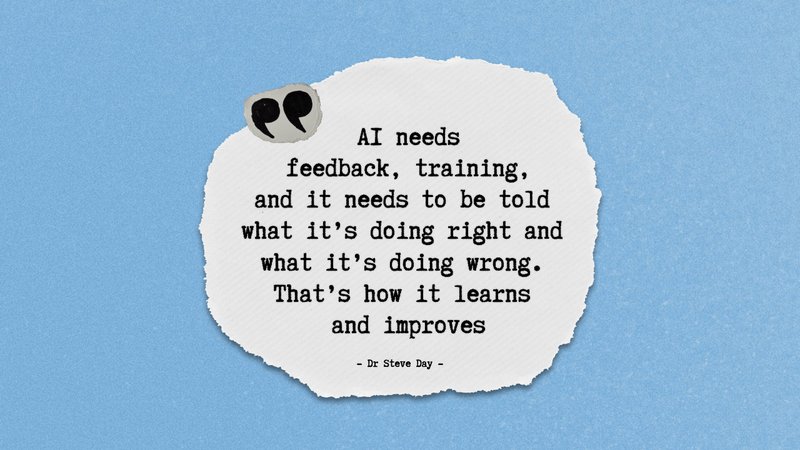
Don\'t do the same thing for AI. Like, it needs feedback. It needs training, it needs to be told what it\'s doing right, what it\'s doing wrong. And it learns and learns and learns and improves and improves and improves. So yeah.
Emilie Schario: Absolutely. And, if anyone doubts this, I would just say go look up a YouTube video with instructions on how to make a peanut butter and jelly sandwich. Because there are so many great ones and they\'re all terrible in the best way.
Dr Steve Day: Yeah. Oh, yeah. If you just wanna have a good laugh, that is a brilliant thing just to pass half an hour. Cool. Okay. So what I would love to get into a little bit more is about the specifics of Kilo.
Because I know we\'re talking- and I could literally talk to you for hours on this stuff with AI, and get more and more technical. But what I\'m really interested in is some of the things we\'ve talked about, the challenges that we\'ve discussed, some of the projects maybe that we\'ve mentioned.
Like, how would my life have been different if I didn\'t just jump into VS Code, open up a terminal window and start typing? If I\'d actually taken a pause and gone, \"Right, this is something I need to build in VS Code. But, I\'m gonna pause, get Kilo involved now before I get started.\" Like what- how would have my experience been hopefully better?
And what would it look like compared to what I\'ve had to spend months trying to figure out and build for myself?
Emilie Schario: Yeah. When it comes to Kilo, I think of it as having, we really wanna meet you wherever you are on whatever interface, is appropriate for you. So if that\'s VS Code, that\'s VS Code.
And that\'s where we\'re most popular for sure. We also have a CLI for people who prefer a terminal interface. We have a cloud, like a web agent, so you could use Kilo in the cloud. It\'s one of my core- let\'s see here if I can show you. It\'s one of my four apps in the bottom of my iPhone. People can\'t see, but I just pulled up my phone.
And so really I think of Kilo as we wanna be everywhere you are. Part of that is, it used to be when you were working on these big coding projects, you would have to log an issue or a task whenever you had an idea. I think now the opportunity is, instead of logging a task, why don\'t you just kick off an agent to start on that task?
So we really wanna be everywhere you are. For a lot of these projects, I think it depends on where you\'re starting from. But we always recommend people start in with a plan. And so Kilo can be your planning partner if you\'ve got strong opinions on, what stack you\'re using or what tools you wanna make available. Or if you don\'t have strong opinions, Kilo can also fill in the gap for you.
I think where Kilo is most beneficial is the recognition that when you are planning, you wanna use a really smart model. So that might be a Frontier Lab model, OpenAI, Anthropic, Google, one of the best of the best. And then when you\'re switching to, actually implement the coding- well, all the models are very good at coding. So you could use a Grok 4.5 or 4.6 or Kimi K3 or one of the open weight models. To have a, just as good coding app at a fraction of the cost.
And so, when it comes to businesses I think more and more we\'re hearing companies of all shapes and sizes talk about their AI spend. And being cognizant of their AI spend. Well, AI spend is a number that\'s only gonna go in one direction, up and to the right. Both as companies reach for more AI to do the things they\'re doing, and they reach for more AI to take on new workflows. And so the best thing you can do when you\'re thinking about managing your AI spend isn\'t, \"Don\'t use AI.\"
You\'re using it because you\'re seeing efficiency gains from it. It\'s making sure you\'re using the right tool for the task, or in this case, the right model for the task. And getting the best bang for your buck. So what is the smartest model that\'s gonna complete the task successfully? And with Kilo, one thing we\'ve heard over and over from our users is like, \"Well, yeah, but there\'s 500 models, and I don\'t know about all of them. And I don\'t wanna have to decide what the right model for the task is.\" We can solve that for you.
We have auto models called, the most popular one is Auto Efficient. And Auto Efficient is really there to help you select Auto Efficient, and we will route it to the right model for the task. So you don\'t have to worry about which one of those models I just talked about you\'re gonna get routed to. We\'re gonna help you solve that behind the scenes.
Dr Steve Day: Well, you mentioned brainstorming or planning in that as well, and how does working with Kilo, doing problem, yeah, brainstorming or planning, how does that differ or better than, say, using Claude Superpowers?
Emilie Schario: They\'re very, very similar experiences, and that\'s intentional.
I think of it as like the superpower comes not from a different interface or a different user experience. It\'s from being able to switch models. So you\'re using Claude today because Anthropic is the latest and the greatest. Tomorrow, that might be a very different model.
Dr Steve Day: Yeah. And, to speaking to that, I spent the first 12 months building stuff in OpenAI. I haven\'t opened OpenAI in eight months.
Emilie Schario: There you go.
Dr Steve Day: Since I got into Claude. And there is definitely IPs sat in OpenAI just doing nothing now because I shifted it or just left it for dead and just moved on.
And that\'s, you know, who\'s to know what the next, where the next jazz is gonna be. And so I can see massive benefit of being model independent and building stuff. And what are the other main advantages other than model independency of using something like Kilo?
Emilie Schario: For an individual business owner, it\'s really that opportunity to choose the right model for the task and leaning into our auto routing. Where we can help you get the best bang for your buck. There\'s lots of, a lot of businesses will wanna connect to their own models, especially large enterprises in highly regulated areas. There\'s more around governance and security that Kilo can offer them.
Dr Steve Day: Yeah, okay. And does it- because I was looking at some stuff about spinning off agents and parallel agents and all the rest of it. Because I think that when I\'ve been doing, some of my bigger builds. Even as a solo- not a solopreneur, but a small business owner just doing it myself, there\'s times when I think the longest I had to let claude run was about seven hours on doing a coding project.
And I\'m, like, keeping going back to it, and I\'m, like saying, \"Are you done yet? Are you done yet?\" Every few hours. It\'s like, \"No, I\'m still working away yet, Steve.\" And so, that the idea of being able to have something- and maybe that wasn\'t something that could\'ve been, I don\'t know the details of it- if it could\'ve been speeded up or not.
But is that a benefit that I should be seeing if I use Kilo? Is like I actually would be able to have maybe more visibility about what\'s going on? It looked from the demos that I\'ve seen and also the fact it\'s actually about to spin off and do things in parallel more efficiently.
Emilie Schario: For sure. I mean, I always tell people, make sure you don\'t bite off more than you can chew. So as you\'re getting started, you might not want to think about running five agents in parallel. One of the great things about Kilo is that we can handle sub-agent delegation for you. So, you don\'t- you can just kind of give the task. And the Kilo can delegate to appropriate sub-agents that are gonna work and manage context and route to different models and kind of all that goodness.
So it\'s up to you on how much you want to control that. You can have long-running sessions. But broadly speaking, I think a typical person is not ready to prompt an agent in such a way that they can work independently for five to seven hours.
Dr Steve Day: I was surprised that I did. Maybe it just got confused.
Okay, cool. Awesome. I\'m trying to think if there\'s any other questions that I really wanted to ask. And I think you mainly covered, you covered the main ones. I think the- what I\'m taking from this is Kilo is open source as well for people to just get started, and have a look at it. There\'s no initial cost involved.
Emilie Schario: No, and you can use Kilo completely for free. Yeah. We work with some of the greatest labs. There\'s always a free model available on Kilo, including Kilo Auto Free. You do your relationship- if you\'re using a free model, oftentimes they\'re collecting that data for training, so keep that in mind as you\'re thinking about that. But you never pay Kilo for an account as an individual.
Dr Steve Day: Cool. So yeah, I said I\'m gonna go and have a little play with and find out. Because this platform independency is like, it is a major concern in going forward. Like, all this cool stuff that I\'m building now is now currently, completely tied to my Claude account in some ways. The fact is, the way I built it with that in mind, I\'ll probably be okay. But most people have learned lots of skills, Claude skills, Claude agents that are very much specific to that environment. And they arguably wouldn\'t know how naturally to move them.
I mean, you can, and it\'s not the biggest pain in the world. But it\'s like actually just thinking about this, I don\'t have to move them ever if I start with a platform that automatically deals with that from day one. So that is hugely attractive and something that I think is definitely worth checking out.
Emilie Schario: Yeah. Thank you. Awesome. I look forward to your feedback.
Dr Steve Day: Yes. Emilie, thank you so much. Before you go, I\'ve got a couple of questions that I\'ll ask you. Firstly, except for Kilo, what other cool software, apps, or tech stuff do you like playing with at the moment?
Emilie Schario: Yeah. I mentioned I live and die by my Todoist. I could not do anything without it. Sounds like you use Asana. Not that different.
Dr Steve Day: Google Tasks, actually, for my own work.
Emilie Schario: Okay.
Dr Steve Day: Asana for my team, Google for me, but there you go.
Emilie Schario: Love it.
Dr Steve Day: Yeah.
Emilie Schario: And then the other, I\'m a really big fan of the voice dictation as changing, as a big thing about changing how people work. And I use Aqua for that personally.
I like what, how it works. It works with my flow. I think there are few things better than being able to brain dump into a coding agent and just speak what\'s on your mind. And then have that broken down into tasks or to-dos or just kind of all of the things at once. But voice-to-text, definitely love Aqua.
Dr Steve Day: Yeah. I\'ve even done a couple of podcasts, not on Aqua specifically, but on voice-to-text stuff. Because it revolutionized, like, how I work. So yeah, love it.
Cool. Last question, Emilie. What- sorry, I should say the title of this podcast is Systematize Your Success, but what does success mean to you and why?
Emilie Schario: Yeah. The ultimate success is a Sunday morning at the beach with my kids. And maybe a little bit of ice cream followed by a Sunday afternoon nap.
Dr Steve Day: Perfect. Love it. Thank you so much. I look forward to checking out Kilo. And, yeah, send you some hugely positive feedback in the future. Yeah. Thanks so much.
Emilie Schario: Thank you. Thank you.
Dr Steve Day: Oh, before I go, I forgot to say, if people wanna get in contact with you, how can they find you?
Emilie Schario: Oh, they can find me on LinkedIn. My name Emilie is spelled uniquely, E-M-I-L-I-E, Schario, S-C-H-A-R-I-O, or Kilo.ai.
Dr Steve Day: Perfect. Thank you so much. Thanks, Emilie. Bye.
Emilie Schario: Thanks. Steve.
VALUABLE RESOURCES (for your AI Coding Agents workflows)
From Dr Steve Day:
- For business apps and AI tool recommendations, visit sys.academy/tools
- Get free access to our DIDACT Framework for quickly capturing the HOW of tasks and delegating them effectively to a human or an AI at sys.academy/guides
From Emilie Schario:
- Newsletter – Playbooks & Priorities: https://playbooksandpriorities.com/
LINKS TO CONNECT WITH THE GUEST
- Website: https://kilo.ai/
- LinkedIn: https://www.linkedin.com/in/emilieschario/
ABOUT THE GUEST
Emilie Schario is VP of Engineering at Anaconda and the Co-founder of Kilo Code, where she focuses on turning AI investment into real business and engineering outcomes. She brings a practical perspective on the systems, workflows, and decision-making that help growing businesses use AI effectively without adding unnecessary complexity.
LINKS TO CONNECT WITH THE HOST
- Podcast: https://www.systemizeyoursuccess.com
- Website: https://systemsandoutsourcing.com/
- Facebook Group: https://facebook.com/groups/systemsandoutsourcing/
- LinkedIn: https://linkedin.com/company/systemsandoutsourcing/
- Instagram: https://instagram.com/systems_and_outsourcing/
- YouTube: https://youtube.com/@drsteveday42
- TikTok: https://www.tiktok.com/@drsteveday42
ABOUT THE HOST
Steve moved to Sweden in 2015 and transformed the way he ran his businesses, switching to a fully remote model. A former NHS doctor with a background in computing and property investing, he now helps overwhelmed business owners systemise and outsource effectively. Through his courses and coaching, Steve teaches how to automate operations and work with affordable virtual assistants, freeing up time and increasing profits. He runs his UK-based businesses remotely with support from a team of UK and Filipino VAs, and is passionate about helping others build scalable, stress-free companies using smart systems and virtual support.
For more articles related to using AI coding agents or AI in general, you may also like:
How I Stopped Copy-Pasting Between Apps and Let Claude Run My Workflows
The Planning System That Stops AI From Adding to Your Workload