
The real work of hiring a virtual assistant starts before they arrive – because the right person can only thrive inside the right foundations.
My first-ever virtual assistant sat there with almost nothing to do.
Ten hours a month on an agency contract. I never used them up.
It wasn't her.
I had no idea what I was handing over.
That's the bit nobody warns you about.
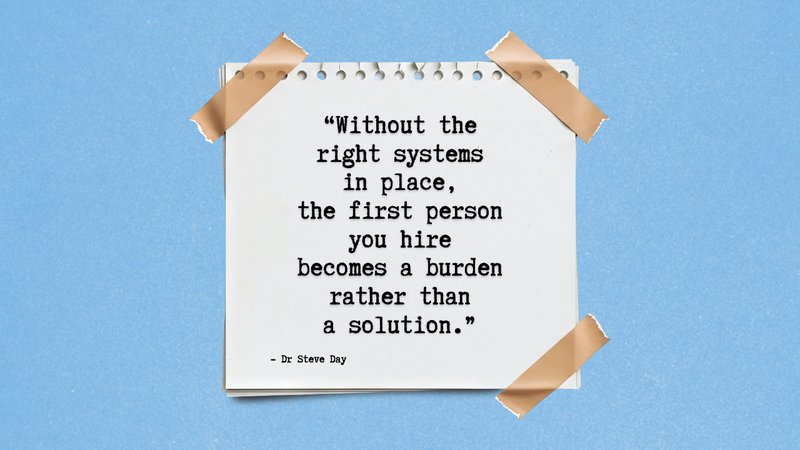
Bring someone in before you've written anything down, and the first person you hire is a burden, not a relief.
You're supporting them, managing them, checking their work, on top of everything you were already doing.
So you decide delegation isn't for you, and you carry on doing the lot yourself.
I sat down this week with Cory Blumenfeld, who's spent the last two years working out why these hires go wrong.
He came at it from the other side, as someone who just wanted a VA, and kept hearing from founders who'd been through three, four, five of them without one sticking.
His answer wasn't about finding better people.
He calls the upfront time a currency.
Put it in early, and it compounds.
Skip it, and you pay it every week instead.
Nobody can start by reading your brain, so the documenting, the instructions, the showing someone how you actually work – that isn't the delay before the hire pays off. It's the thing that makes it pay off.
The part I liked most was what he does when something still goes wrong.
He took a habit from his tech days.
Something breaks, and instead of a word with whoever touched it last, he writes the whole thing up, goes looking for what actually caused it, and puts it in front of the team. Before that, it all lived in a chat everyone forgot about.
I learned the same lesson in a hospital, chairing a committee on patient safety incidents.
People are never to blame.
There's always a system behind it.
Was it the recruitment, the training, the hours, the instructions, or something they needed to do the job that nobody ever gave them?
Get that right, and the first hire stops being the expensive one.
Have a listen – it's a good one if you've already got a VA and it isn't working the way you hoped.
KEY TAKEAWAYS: What to Get Right When Hiring a Virtual Assistant
- Invest Time Upfront to Build Systems – It Pays Off: Building clear systems and documentation when you bring on a virtual assistant feels like extra work at first, especially when you’re already overwhelmed. But if you put in the time now, everything compounds – you free up more time later and set the foundation for your team to grow and succeed without your constant oversight. Don’t skip this step; make that initial investment in process, training, and onboarding.
- Focus on People, Not Just Skills – Culture Fit and Communication Matter: Hiring isn’t just about finding the most skilled person. The discussion emphasised that personality fit, shared communication styles, and compatible work approaches are just as important – if not more so – than skills alone. When you connect with your VA or team member as a person and foster a supportive relationship, you set everyone up for long-term success and retention.
- Blame Systems, Not People – Iterate for Continuous Improvement: When things go wrong, resist the urge to point fingers. Instead, look for the system failure: was it a management, instruction, or process issue? Adopting this mindset enables you to learn from every mistake, fix root causes, and keep improving your operations. As I constantly remind my clients, treating systems as the source of most challenges is the fastest way to elevate your team and your entire business.
BEST MOMENTS: Hard-Won Lessons on Hiring a Virtual Assistant
09:48 – 💬 “It's about finding the right person. Do you connect with this person at a personality level? Do you share a communication style? And do you share a work style? If you have all 3 of those things, then skill can apply.” – Cory Blumenfeld
11:40 – 💬 “If we can create a fully systemized, documented, mapped out business that is crystal clear about ownership of work, about what needs to be done, when it needs to be done, how it needs to be done, by who, and what happens if it doesn't get done, accountability, visibility, all the rest of it, if that bit's in place…you've got the foundation of pretty much any competent person being massively successful in your business.” – Steve Day
16:38 – 💬 “Even if you're in business school, it doesn't teach you about managing people. That's something you learn from actually doing because each individual has a different story.” – Cory Blumenfeld
33:44 – 💬 “The fundamental job that small business owners should be doing day in, day out is just systems iteration, improvement. Because that's how people get elevated up is when you stop blaming people and start blaming systems.” – Steve Day
38:32 – 💬 “I think a lot of people put themselves down and say, "I don't know how to build out systems." But they have a business that's working. They've clearly built out a system. It's just about getting it down on paper and clearly writing it, making it very easy, simplifying it so anyone can understand.” – Cory Blumenfeld
TIMESTAMPED OVERVIEW
00:00 Intro: Hiring and Utilising Virtual Assistants
11:57 Finding the right team members
14:08 Hiring challenges without proper systems
20:16 AI and process automation in business
23:13 Discussing AI and human collaboration
28:05 The importance of human connection
32:46 Identifying and fixing system problems
34:39 Building systems for improvement
37:17 Importance of systems for productivity
42:20 Defining personal success
Episode Transcript
Please note: This transcript was generated using automated transcription tools and may contain typographical errors or inaccurately captured words or phrases.
Dr Steve Day: Taking the leap of faith to hire your first virtual assistant can be pretty scary. There\'s a load of things that can go wrong. There\'s a load of things that can also go right if it\'s done well. The problem is, most of us business owners, when we take on that first person, are already overwhelmed. So the idea of going out and finding somebody, onboarding them, training them, managing them, knowing how to delegate, how- which systems you need, et cetera, that is a massive amount of work on top of your busy workload.
Today, I interviewed the founder of BlueMoso. It\'s a guy called Cory Blumenfeld. He\'s a serial entrepreneur, and he\'s turned his skills to helping small business owners to recruit, managed virtual assistants. He\'s a super nice guy with a brilliant work ethic. And it\'s this kind of entrepreneur who\'s taken a problem they see in the real world. A problem they had themselves, and turned it into a business of passion. One they are truly behind and really believe is making a difference in the world.
I think this interview is super helpful if you are thinking of hiring a virtual assistant, you already have a virtual assistant. But it\'s not working as well as you wish it was, and want to know how to do it better.
We talked about the role of systems, role of AI, and how virtual assistants and outsourcing fits into that. We talked about the benefits of working with a managed service over hiring someone yourself. And also how to get the most out of a virtual assistant when they are working with you. To make sure they become a hugely valuable member of your team. So if you\'re thinking of hiring a virtual assistant, this episode is definitely for you.
Cory, thank you so much for coming on the show. I\'m excited having this conversation with you. I often have a prequel conversation like we did just now. And explaining that I\'ve been helping people recruit virtual assistants. I\'ve been recruiting virtual assistants myself for the past 10-ish years.
And so this is a subject that I have a lot of thoughts about, and I\'m really excited about going into this in more detail with a fellow expert. And learning more about what you do and how you approach this challenge, and the solutions that you provide for people. So welcome to the show.
Cory Blumenfeld: Yeah. Thanks for having me, Dr. Day. Excited to be here.
For the last two years, this is what\'s consumed me, this topic. I come to it from having no experience in this space, and being just a consumer of virtual assistant services. To noticing there was a big problem that needed to be solved.
And accidentally, as an entrepreneur, when you see one of these problems, you\'re like, \"I need to solve that\", and that\'s kind of what happened with me. And it\'s consumed me for the last two years. How do we improve the overall experience of VA services, the lives of VAs, and help business owners succeed in business, not do everything themselves?
Dr Steve Day: Yeah. Awesome. I mean, the reason I say awesome is because about 10 years ago, that is literally the same thought process that I went through. It was just struggling to, back then I was literally a solopreneur. I just left medicine. I was trying to figure out what the hell I was gonna do with my life, start a business.
And struggling under the weight of just doing everything. And then started, heard about virtual assistants in a book I read, and then started looking at, I think it was \"The 4-Hour Workweek\" actually by... \"The 4-Hour Workweek\" guy, can\'t remember his name right now.
Cory Blumenfeld: I had it yesterday. I remember I was saying his name yesterday and, now I forgot.
Dr Steve Day: Tim Ferriss.
Cory Blumenfeld: Tim Ferriss, yes.
Dr Steve Day: And, yeah. And he just introduced this whole world to me I\'d never heard about, and then I started dabbling in it, like yourself. Like you mentioned, and found so many problems with it. So I ended up actually doing, building my own recruitment system. But that in itself is just an ongoing, never-ending part of your world.
And as a small business, that actually I don\'t think is always the best long-term solution. It may fix a short-term solution. But unless you\'re gonna grow it big and have a huge team and stuff, then I do believe that actually getting experts involved where their entire focus is on. Like, how do we find the best people, how do we eliminate everybody else? How do we interview them, how do we test them, how do we actually make sure they\'re a good fit?
That is a full-time job just to actually keep that system live, updated, with all the advent of AI. And, I\'m sure you\'ve got opinions on this. But we, at one point we were getting people just using AI even in live interviews, let alone on applications. So all of that malarkey.
So yeah, something I\'m, as I say, I know a fair bit about. I\'ve done a lot with it myself over the years and helped other people do it. And so, I\'m really excited to hear and speak to somebody who\'s fresh in this. This is the passion at the moment. This is where your drive is.
And so what made that shift for you? Or why was it that you, I know you mentioned, you saw issues, but what were those issues you\'re seeing? Like, why did you evolve, pivot, whatever word you wanna use into this arena? And maybe, tell us what you were doing before and where you see things going in the coming years.
Cory Blumenfeld: Yeah. So before this, I was a tech guy. And before I was a tech guy, I thought I was gonna be a doctor. That\'s all I wanted to be. You made it into the healthcare system. But you know, I was in my last year of school and I was in a pre-med program. And I always wanted to innovate and change the healthcare system.
So, I was struggling in school. I started taking a course, entrepreneurship for science students. My friend at the time was building a business, becoming an entrepreneur. And the professor in that course was like, \"You seem really passionate about healthcare. You seem very creative. Like, why aren\'t you just building something?\" And I\'d grown up with this idea that you had to have the piece of paper to actually make a difference.
So, flash forward a couple years, it took me a while to find the team. I started building that. Okay, so I built two tech businesses in the healthcare system. I don\'t know about you, but working in healthcare, it\'s a very tricky system. It\'s very hard to make change. So it kind of, I kind of got burnt out from healthcare. So when I exited my last business, I was like- I was trying to figure out, what am I doing next? Kind of like what you were saying, what happens after all this?
And one thing that I really wanted to do, and I felt like I missed throughout all this business experience, was putting myself out there, creating my own personal brand. I had a hypothesis that if I put myself out there and I start creating content and something will find me, the problem will find me.
Because a lot of times in the past, I was- I used to go searching for the problem. So both healthcare companies, it was like I needed to be in healthcare. I needed to solve a problem in healthcare. So I forced that upon myself. This time around, I realized the business case would find me. So started creating content, and that became a full-time job.
It was a ton of work. And at the time, I got- I started doing a contract position as well. And I needed to balance both, so I brought in a virtual assistant. Because it- I decided I wanted- I saw the value in continuing to build my brand. So brought on the virtual assistant, and I realized from my last two businesses, in order for this person to succeed, I needed to document everything.
I couldn\'t expect them to just tap into my brain and take all that knowledge. I had to build the systems out, I had to document, I had to provide them with instruction. And it started to really work. I was growing, I was thriving in my work. And people started to notice, and so people would reach out to me.
They loved my content. They wanted to chat. I started chatting with them, having really good conversations. And the I kept hearing, \"Oh, how are you getting your VA to work with you? This is a struggle for me. I\'ve gone through three, four, five VAs. I can\'t find anyone. I\'ve gone through all the websites like Upwork and some...\" I don\'t like to name drop, so I don\'t want. \"But, we were going through all these different platforms, and we weren\'t having success\". And I was like, \"I\'m having a ton of success.\"
I built out this system, I provide instruction. I make it so they understand I am doing just as much work as them to show them how motivated I am. And how important the work they\'re doing is because I know it\'s not the most fun work.
And people started to say to me, \"Well, can you help me with this? Does your virtual assistant have any more time?\" And I was getting close to my virtual assistant at that time. They were like family. So I asked them, I was like, \"Do, you want some extra work? I think I can get you some extra work. I can help manage this for you. It will be, it won\'t be too difficult.\"
And, fast-forward, around two years, we have over 80 virtual assistants in our talent pool. That virtual assistant is my business partner out of the Philippines, Cha Romero, amazing person. And yeah, we\'re growing, so it was totally accidental.
But as we were doing this, we noticed a lot of times it was the founder, not always the virtual assistant. But the founder didn\'t know how to identify the right skills, right? They didn\'t know how to identify the right individual. And that\'s what our model\'s all about now. It\'s finding the right person.
Do you connect with this person at a personality level? Do you share a communication style, and do you share a work style? If you have all three of those things, then skill can apply, right? But it doesn\'t matter if you have the most skilled person. And, we learnt this by trial and error.
And so, hiring my own virtual assistant led to this because I realized a lot of virtual assistants aren\'t treated fairly. They struggle to find opportunity. And then business owners just they need the systems in place. They don\'t have time to build the systems, and then manage the individual and set them up for success.
Dr Steve Day: Yeah. Yeah. I completely resonate with that. And it\'s the same challenges that I saw time and time again with the clients I work with. Is that in the early days I used to place virtual assistants with our clients. And we would go to a huge effort to try to find someone who\'s good. We\'d be testing them, we\'d be interviewing them, we\'d be doing personality tests and aptitude tests and real life tests, and everything looks great.
And then you put them with a client and a few weeks later there\'s complaints, there\'s things that are happening. There\'s no communication at all, there\'s never had a meeting. And things aren\'t working out. And so I end up building a whole training for how to manage virtual assistants.
It\'s called the Virtual Assistant Management Toolkit, it was called back then. And this is all about this. It\'s how do we actually equip business owners to be better managers for remote teams? And whether it- well, remote or any team. Because a lot of business owners never have had employees before.
And that definitely took a shift in the right direction. But what you mentioned there and where my passion has always been, the name of this podcast is Systemize Your Success. It\'s all about systems, it\'s about, what you mentioned, about documentation. It\'s if we can create a fully systemized, documented, mapped out business that is crystal clear. About ownership of work, about what needs to be done, when it needs to be done, how it needs to be done, by who? And what happens if it doesn\'t get done, accountability, visibility, all the rest of it.
If that bit\'s in place, which is easier to say than it is to create. But then actually you\'ve got the foundation of pretty much any competent person being massively successful in your business. You don\'t rely on having to have experts to do something for many things. Because just the fact that you\'ve documented it really well means that it\'s now more of an admin.
And what you\'re now looking for, like you mentioned, do they have a personality match? Do they communicate well with you? Are they competent? And those combined, I think, is what I\'ve seen clients that have actually started to focus on their systems, found a good person through someone like yourself, like hiring. And actually getting a decent person in, that\'s when they just go bang. And it doesn\'t have to be a virtual assistant. It could be a member of staff. It\'s like-
Cory Blumenfeld: Yeah
Dr Steve Day: That\'s the combination, the sweet spot.
Cory Blumenfeld: Yeah. And I think the one thing I\'ll add to that is the time investment, right? I know as a business owner, a lot of times it feels like you don\'t have that upfront time to invest.
But- I\'m writing an article on this. That upfront investment in time, that\'s a currency. And if you invest that time early on, it pays off in dividends in the future. And right, it compounds. And a lot of folks feel like they don\'t have the time to do that. I understand. Sometimes you just want someone to come on and just start.
But the truth is, a person can\'t just start understanding your communication style. They can\'t just understand your work style. They can\'t read your brain. And so it\'s important that you do invest that time. For us, we try to help with that by managing an individual. But you know, for a lot of business owners, they feel like they don\'t have that.
And I think, it\'s important. If you are going to hire someone, you have to make that investment. You have to commit to making that investment. It\'s hard to bring on someone if you\'re not willing to do that. And I see that as kind of a tension or a failure point sometimes for a lot of business owners. Because they think someone will just come on and solve everything. And I don\'t think it\'s the case even with the most highly skilled individual. In most cases, I\'d say, in small business. They are the outliers.
Dr Steve Day: Yeah. But I think it often comes from a point of desperation, I think, for a lot of business owners. They\'re so overwhelmed and they\'re just firefighting. And, for a cliche expression, they can\'t see the wood for the trees. They\'re like just stuck in the mess that they\'ve created for themselves. And the idea of then, when you bring somebody in, it\'s gonna take you more time than you already have for them to do the work that you would\'ve done anyway.
So that initial part without systems, without the- whether it\'s onboarding systems, training systems, SOPs, maps, et cetera, whatever it is. Without that stuff in place, literally the first person you hire is a burden. Because you\'ve got to support them, manage them, delegate, check their work on top of all the work that you\'re doing as well.
And that is the thing that, like... And it should put some people off. It should make you think twice before jumping in and hiring. Because hiring itself is a huge amount of effort and money. Just to waste it and the person not succeed is just a total waste of time and effort.
And so, but it\'s that, it\'s just that, I think, having the right expectations about what it means, what\'s required to bring in your first assistant. Whether that\'s a staff member or a virtual assistant. And being prepared for that. And being prepared, like you said earlier, it\'s the investment time now that compounds over the years.
Because once you\'ve done that once and you\'ve nailed it, then it\'s just rinse and repeat. Because you\'ve started to build the processes needed to bring the next person. And the mindset and the skills and the management skills. And all those things that you can\'t just get from books. You need to actually practice doing it. So yeah.
Cory Blumenfeld: No, exactly. It\'s never easy the first time. It took me... I\'m on my fifth business now, and it took a while, right? The first business I- my first tech business, because I had a business before that, but it wasn\'t... it was to pay for university, was when we started hiring people, and I called my MBA. My second business was the continuation of my MBA.
It takes a while to really understand. But, if you\'re building something, you\'re experiencing early success, a lot of times, even if you\'re in business school, it doesn\'t teach you about managing people. That\'s something you learn from actually doing. Because each individual has a different story. They have a personal life, they... And that bleeds into work sometimes.
And learning how to manage that individual, making sure that they\'re successful, learning how to do things as a team, to motivate people. Yeah, it\'s not easy and it comes with time. And, just going into it, you need to know that there will be an investment in time. And if you\'re not willing to do it, you\'re not setting up the relationship for success.
Dr Steve Day: Yeah. I think that\'s why I like the idea of what you do is, it\'s- because when I started, I did it all myself. No, I lie. The first ever virtual assistant I hired, I got a contract with an agency. And it was like 10 hours a month, and I never even used up the 10 hours. I just had no idea what I was doing, so except for that, bad example.
But beyond that, it\'s like I always went and did it myself. But then it was just like learning through failure and failure and failure. And like looking back, I wish I\'d just had the insight to say, \"Look, if I actually just got someone,\" like what you do. So from my understanding, it\'s a managed service. It\'s not just \"Here you go. Good luck.\" There\'s more to it than that.
And that is the thing that it took me a couple of years to just figure out and design systems around. And make all the mistakes and lose all the staff. Some of them, looking back, were brilliant people. And I lost them through either me being an idiot or my systems being a total mess or just me just not understanding how to manage effectively.
And it\'s a shame that so many people go through that pain to- before they suddenly, \"Okay, now I get it. Now I can sort of stand on my own two feet a bit.\" And I think that\'s what I love about the kind of thing that you offer. Is that it gives people a way of offloading without having to be that experienced manager, delegator, systemizer from day one.
They can learn a little bit more on the job, so to speak. Because there\'s someone else there to actually support them and help them to get it right. So I think that\'s really, really cool in what you guys are doing.
Cory Blumenfeld: Thank you. For us, I\'ll get on calls with prospects. And we\'ll have a conversation, and they\'ll be like, \"Well, I only wanna pay this per hour,\" right? Like a low rate. And I\'m like, \"That exists,\" right? You can go on Upwork, these other platforms, and you can find that. But what you need to understand is you have to manage that individual. You need to set that person up for success. I always point them in the direction, right? If they\'re looking for the cheap alternative, they need to understand what they\'re getting out of it or what they have to put into it.
And so, the important thing, right, in all cases comes back to exactly what you\'re saying. It\'s the system and how you manage the individual. So you can be successful with someone that you find at a low hourly rate. You really can. You just, you have to build out the system, right? Or you can come to someone like, you that has the systems in place, or you can come to someone like me that will help manage that individual, right?
That will spend time, that will help with the delegation. But, it\'s just knowing up what you\'re signing up for, right? And I find that a lot of folks will- they\'re not thinking of getting an outcome complete. They\'re just thinking of the overall cost, they\'re not thinking of it in terms of ROI. They\'re just like, \"I just want someone cheap to work on it.\" And that\'s not always the best solution.
Dr Steve Day: Yeah, I mean, I think that in my world, an ideal person coming in to work with me now is someone who\'s gone to someone like you. They\'ve got a virtual assistant, they\'re delegating work out, and now they wanna systemize the hell out of their business. They wanna make this rock solid, scalable, like, franchisable, whatever that word you wanna put into that- saleable. And they want this business to run with a team of people that isn\'t them, and get everything out of their head, what I call getting your vision into operational flow. That\'s what I help people do.
But for that to happen, it can\'t just be the business owner. I mean, we are using a lot more AI now. So we\'re using AI for operation manuals, for managing staff to some extent, the technical sides, not the people sides. And then moving forward we\'re using AI for process mapping and building projects. So there\'s a load of stuff on the horizon for what AI\'s gonna be helping to help teams work more effectively and get those systems built.
But for me, if somebody comes to me and they\'ve never hired someone before, then there\'s a lot of work we need to do. To get them to the point where they really benefit from, they need systems, they need this stuff down. Because that really only becomes essential when you\'re at that point of, \"Okay, now I need to delegate this to somebody else.\" Or it can be to somebody or to something these days, so you can delegate to an AI. But there needs to be an established business in some respect for it to really make sense.
And so that\'s why, again, I love speaking to people, connecting with you on this kind of show. Because I think that what I do will support your clients, and what you do will support my clients. And that\'s, I think, is just the... And it\'s evident in what the way, I think we\'ve talked pre-show as well, what we actually think of how we approach this? The things we think about, like actually looking after the livelihood or the caring for the people on the other end.
Even though you may never meet these people. It\'s like I\'ve been working with my current virtual assistant for five years or so now. And, we meet every single day. We speak every day. I know about her family, I know about, whatever. It becomes somebody just like they\'re working in an office with you.
Yeah. And you meet them and you build a relationship with that person. So I\'m super- an advocate for actually treating people like people, and that is something that I don\'t think I did very well before I did medicine. And it was through my years of being a doctor and the training I went through, and obviously the job itself. That it changed fundamentally how I approach other people. Whether it\'s staff members or the general public. And that I brought back into my business world. And, yeah, that end up bringing me to speak to you today, I guess.
Cory Blumenfeld: Yeah. You said a couple things that we could easily have a whole show about, right? It\'s like the AI component. Every day I have people coming to me, \"Well, how\'s AI impacting your business? Is there even a need for your business?\" Or, \"Can\'t I just get AI to do this?\" And, my whole belief and everything I\'m writing about these days, it\'s AI plus the right humans, right?
Yeah. So there\'s a whole conversation there about this. Because AI, people are starting to mix up what the purpose of AI or what AI\'s really good with versus where humans come into play.
AI\'s great at repetitive task work. I don\'t think humans like to do repetitive task work. I know that the VAs I work with, they dislike repetitive task work. Because there\'s no purpose in it. There\'s no fulfillment. There\'s no decision-making. So, when people come to me and say they\'re using AI, I\'m using AI every single day.
I\'m creating- because my capacity\'s going up, I\'ve the need for more virtual assistants. Because I\'m able to do more and I need to hand off more processes. I need to hand off more systems. Because we\'re able to move faster. So that\'s a huge component. The other thing that you said, and again, and whole treat people like people, these are people at the end of the day, right?
And I\'ve had people not pay. I\'ve had people say horrible things, not willing to be patient. It\'s just, it\'s sometimes, it\'s sad to see humans treat other humans like this. Because at the end of the day, it doesn\'t matter that they\'re overseas, they\'re not in front of you right now. They are people, right?
And when you start treating them, that\'s when people go above and beyond for you. And so I see this all the time. That folks just- they\'re not that nice. And then the third thing that you were saying, it\'s like we are- it\'s that proximity you\'re creating, right? And this is the important part.
We are in an age where, you know, it makes- you can outsource pretty much anything, and you don\'t need to be in the same room with a person. And I think, we\'ve gone through this transition where we need to create in-person moments online, through cameras, right? And you can do that, and you can create relationships.
You were talking about you\'ve had your same VA for five years. You know their family, you know everything about them, right? My business partner was my VA. Her family is like my family. I actually went to meet them this year in the Philippines. Beautiful, beautiful country. I went to meet my entire executive team and a bunch of the VAs that we\'re working with.
But, it was funny when we were meeting in person, they were saying it feels like I see you every single day. It just feels natural, right? And you can create those moments. I actually think it\'s important as a business owner that\'s working with a virtual assistant to create those moments. Make it feel like you\'re in the office, you can. And it takes a skill to do that.
Dr Steve Day: It does. It does. I\'ve got, one of my clients, a guy called Georges, who I\'ve actually interviewed on this podcast a couple of times. And once was about this particular subject. It was about how to create better relationships with your virtual teams. Because he\'s got more than half of his team now is based in the Philippines.
He\'s seven or eight virtual assistants now in the Philippines. And they\'re running- they basically run the whole entire business. You say virtual assistants, that\'s not their role. They are the office manager, they\'re the sales director, they have proper titles and responsibilities beyond anything you can imagine. If you\'ve never worked with outsourcing before.
And, but he has spent so much time and energy, because it\'s something he loves, I think, about building these moments. So they do pizza Friday, and they do these game, Christmas they\'ll do a games night. Yeah. And then, like they do a cook-off, and they\'re all actually in their kitchens together cooking the same meal trying to compete and whatever.
And all these things that have brought his team so close, and he does it with the UK team as all synchronously. But all via Zoom. And I think that those are the things that, I mean, he\'s hands off. I\'m way behind in some respects than him and many of the clients I\'ve worked with.
But that human element, again, it\'s like that\'s- there\'s so much joy to be got. As, as well as humans, I think we are programmed to want to teach, to want to share knowledge, to help other people to grow. That\'s why we as a species have been so successful. And so if we take that away and we just sit there and work purely with our own minds and automations and AI. We can lose a big chunk of that.
That\'s why I became a coach. Because I love to teach, I love to share the things I\'m passionate about, so technology and systems. Those are things that I spend all my day, paid or not, playing around with. I\'m going on holiday next week, and I promise you at some point I\'ll be jumping on my laptop and messing around with AI. Because it\'s a hobby for me. I just get paid for it.
And I think that like, that is- if we just get rid of the humans from all businesses, then we\'d, just... you have no connection. And I\'ve talked about this lots in the podcast recently. But there\'s no connection to that, the business in the same way, because it\'s just you. And so the purpose of that become, can be more difficult to find.
But also, if you don\'t have- like, people buy from humans, which is a common expression that people say. It\'s like, when I\'m looking for a service, like I often look to the founder. I wanna know the story behind it. That\'s the first thing I ask any person that come to this podcast, like, \"Why do you do what you do?\" Like that book, \"Why\" by Simon Sinek. It\'s \"Why is it that you chose, of all the things in your whole world you could do, you chose this?\" And, you\'ve got a story behind that.
That\'s the uniqueness of your business compared to, say, the next person who\'s doing recruitment for a completely different reason. And that will resonate with some people, and it won\'t resonate with others. And those human connections are, I believe, what the fun part of business is all about.
Cory Blumenfeld: Yeah. Yeah, no, you- exactly. Like in today\'s world, and I was talking about this yesterday on another podcast, like this was a topic. It\'s that connection you can create online. And this is another thing that I think folks struggle with, right? Because we\'re all, we\'re coming from this world where it\'s like you have to be in the office, conversations by the water cooler. And it\'s creating that connection on a screen, and it takes real talent to do it.
But I don\'t see it as really anything different. It just doing what you would do. For my team, for example, yeah, we do the games, right? Cha organizes the Christmas party and they do all these different holidays. And they put together all these games for everyone. They organize meetups in the Philippines. Sometimes they\'ll rent an Airbnb.
When I went there, we organized karaoke night, and brought people in. But other than that, we\'re co-working. Throughout the day we go on a Google Meets call, put off, turn off our mics. We sit there. It\'s like we\'re in the same room. What\'s the difference? If you\'re in an office, you\'re working in silence.
Dr Steve Day: Yeah.
Cory Blumenfeld: We\'re constantly, we\'re not just chatting about work. I send the team some of the folks to go and get massages or get their nails done. Because, at the end of the day it\'s important. The other thing that I make sure of, right? I come last, they have to come first. They have needs. They\'re doing a lot of hard work. I need to show them that they matter. And so, right now, and I think it\'s important for a lot of business owners, it\'s you put the team first. Put the team first, always. Like I put them first.
If someone\'s gonna take blame, if someone- a client has a problem or they\'re not being nice, I tell them, \"Say it to me. Okay? Say it to me. Don\'t take it out on the team.\" I have to protect them. And that\'s super important for creating relationships. Knowing that I\'m there to protect them, that I\'m gonna put them first, their needs first. It\'s important.
Obviously, I can always do better, and I wanna do better, right? And that\'s kind of my mindset. I wanna give them more. There\'s nothing more that I wanna do than make sure that I can support everyone. And it\'s not always the case. But, we\'re working towards it. We\'re working towards giving more. Setting up programs for our team. And I think this, like, when you give back to them, when you show them that they matter, and you create these rich experiences, that\'s when they do their best work.
Dr Steve Day: Yeah, and I think following on from that, which I totally agree with, is taking ownership. And as a business leader or a business owner, it\'s very easy to cast blame. And one of the things I learned, again, back in medicine, I chaired a committee called the Lessons Learned Committee. It was about looking at patient safety incidents in the hospital and identifying the root cause.
And in our work, there\'s a huge emphasis on the people are never to blame. It\'s always a system problem behind that. And whatever, whether it\'s going as far back as why did we recruit this person in the first place? They\'re the wrong person for the job. They\'re the wrong person in the wrong seat.
That\'s a recruitment system problem. Or is it a management problem? Was it they were working too many hours? Or is it they didn\'t have the support or the training they needed, or was the thing that they needed to do the job properly not available? There\'s always a reason that can be fixed. And if it\'s a system problem, then the only person that\'s left to blame is the person that leads that, which in most small businesses is the business owner. If you get a slightly bigger business, you may delegate that down. But for most small, medium-sized or small businesses, it\'s gonna be the business owner.
And that\'s something that I have tried to instill into my coaching clients, is if you can look at the world through that eye, suddenly that when something goes wrong. When someone\'s messes up or they don\'t do what you expect them to, the first thing to ask is, \"Okay, is it a system problem? Was it a delegation problem? Was it a management problem, was it a instructions problem? Was it like, where did that problem actually come from?\"
And having a frank conversation with somebody and trying to get them to be honest about what they think went wrong. And finding and fixing that bottleneck that cause that block, or whatever you wanna call it. Like that, to me, being a systems guy, of course I\'m gonna say this- but that is for me, the fundamental job that small business owners should be doing. Day in, day out is just systems iteration improvement. Because that\'s how people get elevated up, is when you stop blaming people and start blaming systems. So yeah.
Cory Blumenfeld: Completely agree. We- as I mentioned, the mindset we\'re always trying to get better. We implemented this new process, new system, and we had, I would say, an incident. And I remember back in my days when I was in the tech space, there was a thing called a postmortem. We break down exactly what\'s happening. It\'s just another system for understanding the problem, understanding the root cause. And then understanding the steps you\'ve taken to correct it so it doesn\'t happen again.
And you\'re also documenting it and then discussing with the entire team. So we\'ve actually just implemented this. Now, we\'re not all in the same room, so we can\'t meet to discuss it. But it\'s something we can do async. And so, these are little systems that we\'re implementing to get better, right?
We\'re always finding new ways to get better. Before, feedback, all this, when issues happened, they lived in a chat that we forgot about. And if the same things keep happening again, it really comes down to just building out a system around it. And that\'s kind of how I think. The great thing about having ADHD is I have to build systems for myself to stay on top of things.
So I\'m not a- I never started as a systems thinker. But I realized for me to be focused, to be on top of things, I had to create systems for myself. And so it\'s become a huge part of the business to build out SOPs, to build out process. One, because I know that for some reason in today\'s age, we\'re easily distracted. The shiny object\'s there, everyone wants to go chasing after it. And so, we\'re just- every day we\'re thinking of new systems.
We\'re not- system overload is a real thing, so we\'re trying to be really focused on the systems we build out. But if there is a problem, like you said, it usually comes down to there being a missing system in place. And it can easily be fixed with a system. So yeah, completely, completely agree with that. And just the postmortem is a clear example of what we were missing.
Dr Steve Day: Yeah. And, as a fellow ADHDer and similar reasons for falling in love with systems is that before I knew or knew what systems were in a business context. Like I look back and all of the coping mechanisms that you put into place when you are highly distractible and terrible short-term memory. And all the things that come along with having an ADHD mindset.
And when I read, I remember reading \"The E-Myth\", is when I was running a business in Australia, I went on holiday and ended up investing in a company. Like you do. And the whole thing was falling apart, and I ended up just picking up this book that my dad had given me, many years before, and I\'d taken it with me traveling.
And I read \"The E-Myth\" by Michael E. Gerber, and I was just suddenly, \"Ah, that\'s how you do it.\" And suddenly, like that was the pinnacle moment in my life of if I can just get this stuff down. Then I won\'t forget what I\'m meant to be doing, and other people won\'t either. And it was that fundamental shift of, \"Ah, okay. Now we\'ve got a plan.\" And it took me quite a while longer to actually get it into practice and I even went into medicine after that.
So it was a good like probably 15 years beyond that it really started to pay dividends. But it was that, I remember, exactly where I was sat when I had that epiphany, if you like, to this day. And, yeah. So I think that for people like us is like understanding the necessity of systems is something we\'ve had to just learn by through just life. And I think that if that\'s not the way that you\'re programmed, if you are quite capable in some ways. And then it can be, it\'s like, \"Well, if I can just get on with it and do it myself, then surely everyone else can.\"
And that I think is one of the mindset shifts that people may take a little bit longer to get to. If they don\'t have a brain where they actually really, really benefit from systems from day one. And so again, that\'s one of the things I work with a lot of my coaching clients. Surprisingly, many of my coaching clients also have ADHD. But actually the ones that don\'t, they\'re sometimes slightly more challenging to get them to focus on that. So anyway.
Cory Blumenfeld: Yeah.
Dr Steve Day: Bit of a random tangent, but very interesting in my world anyway.
Cory Blumenfeld: Yeah. Look, you know this better because I was looking at your website. It says this on there. The number one thing I always hear from business owners when I\'m talking to them is I\'m like, \"Okay, so you\'re doing well. Your business is doing well. You wanna bring on someone. I\'m not- they\'ll say I\'m not a systems thinker.\" It\'s all up here. It\'s all up here.
But I\'m- you\'ve obviously, you know, I think a lot of people put themselves down and say, \"I don\'t know how to build out systems.\" But they have a business that\'s working. They\'ve clearly built out a system. It\'s just about getting it down on the paper. And clearly writing, making it very easy, like simplifying it so anyone can understand.
And but that\'s the number one thing that I hear from folks when they\'re thinking about- when we\'re talking about building out, bringing on a VA. It\'s they don\'t have any systems. They suck at it. They need help with it. But the reality is I just think, I don\'t know what it is, why people struggle, right?
There are a lot of tools that can help get these thoughts out of their head. Maybe they need someone like you to help them get the systems out of their head. But yeah, it\'s just, it\'s very interesting. Because that\'s always the number one problem I hear. I just- I suck at making systems. It\'s all, all up here. I know what to do, but I can\'t get it, I can\'t get it onto paper.
Dr Steve Day: Yeah. I mean, that is fundamentally why my business exists. Because of that single challenge is. And so what our academy is all about is training the business owner about systems. But really importantly, training typically the virtual assistant on how to build those systems.
And so the academy is that how does the business owner communicate their ideas in a way that somebody capable can then document and build their business below them? And so that exact piece you\'ve just described is the reason that I do what I do. Because that\'s exactly the challenge that I had.
The challenge that you just described is so common. And so when someone, they come to someone like you and hire a virtual assistant that\'s super capable, right? Great. Now we need to get that person to be the systems thinker in the business. If the business owner isn\'t that way inclined, great, then we get somebody else to do that for them.
And that\'s where we see, yeah, businesses just rocket in terms of how consistent stuff\'s done. And the, well, the systemization of the business, for a better way to say it, is by delegation of, not abdication, delegation of a lot of those responsibilities. So the business owner can just keep on doing the stuff they love doing. And so, yeah.
Cory Blumenfeld: Yeah. Yeah. No. Exactly.
Dr Steve Day: Awesome. Cory, I could- I say this many times, but genuinely I could keep on chatting to you for hours on this stuff. And- but I\'m gonna have to draw this to a close. But there is one thing that I would, or two things I wanna ask you, actually. Firstly, you said you\'re a tech guy, so I\'ve got high expectations of the answer to this question. So, no, no pressure now. But what apps, technology, fun things are you using in the tech world at the moment that you couldn\'t live without?
Cory Blumenfeld: Yeah. I mean, Claude, ChatGPT, Notion. We\'re building a lot of systems on our own using tools like Replit, so custom software. Anvil, for forms. We\'re using tools like Viktor to automate processes.
Dr Steve Day: What\'s Viktor?
Cory Blumenfeld: It\'s an AI employee.
Dr Steve Day: Yeah, okay.
Cory Blumenfeld: It\'s a newer tool. You plug it into Slack. It has all these different connectors. It can document stuff for you because there are a lot of conversation lives in Slack. There\'s so many tools that I\'m using these days, but-
Dr Steve Day: What do you use, what do you use Notion for?
Cory Blumenfeld: Documentation.
Dr Steve Day: Yeah.
Cory Blumenfeld: Databases. So everything lives in there. It\'s a shared database. Yeah. We- yeah, Notion is where everything lives for the most part.
Dr Steve Day: Cool.
Cory Blumenfeld: So, yeah.
Dr Steve Day: Okay, awesome. And final question for you. The name of this podcast is Systemize Your Success, but what does success mean to you and why?
Cory Blumenfeld: I mean, if we\'re looking at delegation, right? Or just why I got into business, I think it was to take back my time. And to really have the freedom to choose what I work on, right? So in my mind, that\'s what success is.
The other thing that I would say is waking up happy or fulfilled. I think that\'s the best way. I know there are days that I\'m not gonna be happy. But you know, as long as I\'m working on something that makes me feel fulfilled, I would say that is what success is, right?
Not monetary. Yeah, sure, that comes with society\'s definition of success. But as long as I feel fulfilled, that\'s when I\'ll know that I\'m successful. And I feel fulfilled right now. So I feel successful.
Dr Steve Day: Good answer. Yeah. My mantra is to live more presence, purpose, and peace. And that\'s something that took me a long time to come to realize that that is fundamentally what success for me is all about.
And, similar to you, fulfillment and, yeah, and all of the above is, and joy and happiness, above anything else. And I think that it\'s interesting. I\'ve asked 100 and something people I\'ve interviewed on this podcast, probably more than that now, that same question, and I think only one has ever mentioned money as a measure of success. And everybody else, it\'s time, it\'s choice, it\'s freedom, it\'s fulfillment, it\'s purpose, or some mixture of those things. So yeah, totally resonate. Awesome.
Cory Blumenfeld: And I say one last thing, you know, I\'ll know that this business is successful when I\'m providing the life I want to the team, right?
Like I have a goal, and I wanna give back to them. And I wanna make sure that they truly are taken care of, right? I wanna see them getting paid fairly. I wanna see them getting treated better. And, as we bring on more team members, I think for me right now, what I\'m chasing in terms of my success, is making sure that the individuals that are working with us are taken care of.
So it\'s a little passion project right now, and hopefully it comes true.
Dr Steve Day: Awesome. I hope so too. Cory, if people wanna get in contact with you or learn more about what you do, how can they best find you?
Cory Blumenfeld: Yeah. You can find me on LinkedIn. That\'s my main channel right now where I\'m posting content, but just started Substack. You can find me-
Dr Steve Day: What\'s your LinkedIn handle?
Cory Blumenfeld: LinkedIn, it\'s Cory Blumenfeld. And then Substack is, I have a- the newsletter there, \"Taking My Time Back\". And I also just started a podcast. Haven\'t released it yet. It\'s called \"Taking My Time Back\" as well. You can go to www.bluemoso.com, so B-L-U-E-M-O-S-O.com.
And yeah, I\'m always available. I\'m on Instagram as well. So creating a lot of content these days. But, yeah, always happy to have a chat around how I can help folks take their time back.
And Dr. Day, the most important thing, this is how I end every call. I don\'t know if you know this about me, but this is part of my brand. I end every call with a fist bump, so boom. Thank you for your time, and thank you to your audience for listening. I really appreciate it.
Dr Steve Day: Awesome. No, thank you for coming on the show. Really enjoyed today. Thank you.
VALUABLE RESOURCES (for hiring a virtual assistant and effective delegation)
- Get free access to our Recruit Right Framework for hiring the right people for your business and our DIDACT Framework for quickly capturing the HOW of tasks and delegating them effectively at sys.academy/guides
- Join our private, focused, and supportive community designed for freedom-driven entrepreneurs at join.sys.academy
Link to previous episode mentioned:
LINKS TO CONNECT WITH THE GUEST
- Website: https://bluemoso.com/
- LinkedIn: https://www.linkedin.com/in/coryblumenfeld/
- Instagram: https://www.instagram.com/coryblumenfeld/
ABOUT THE GUEST
5x founder with 2 exits, Cory is a self-described biz generalist with 10 years of experience across startups, operations, sales, and product. His companies have raised nearly $5M, and he has built an audience of 67K+ followers on LinkedIn.
Cory has started 5 businesses, despite having no prior experience in the industries he entered. He is currently the founder of BlueMoso, a company he says started almost accidentally.
Today, Cory is on a mission to help 1 million business owners grow their businesses and get their time back.
LINKS TO CONNECT WITH THE HOST
- Podcast: https://www.systemizeyoursuccess.com
- Website: https://systemsandoutsourcing.com/
- Facebook Group: https://facebook.com/groups/systemsandoutsourcing/
- LinkedIn: https://linkedin.com/company/systemsandoutsourcing/
- Instagram: https://instagram.com/systems_and_outsourcing/
- YouTube: https://youtube.com/@drsteveday42
- TikTok: https://www.tiktok.com/@drsteveday42
ABOUT THE HOST
Steve moved to Sweden in 2015 and transformed the way he ran his businesses, switching to a fully remote model. A former NHS doctor with a background in computing and property investing, he now helps overwhelmed business owners systemise and outsource effectively. Through his courses and coaching, Steve teaches how to automate operations and work with affordable virtual assistants, freeing up time and increasing profits. He runs his UK-based businesses remotely with support from a team of UK and Filipino VAs, and is passionate about helping others build scalable, stress-free companies using smart systems and virtual support.
For more articles related to hiring a virtual assistant, you may also like:
Everything I've learned from hiring over 160 Filipino Virtual Assistants (PART 1)
How I Stopped Doing Everything Myself—and Outsourced to My First Virtual Assistant