
Effective delegation starts with one simple shift: creating the time and structure to finally get work off your plate.
You hand someone a task. It comes back wrong.
So you fix it yourself and decide delegating isn’t worth it.
I’ve watched that loop play out hundreds of times.
I’ve lived it myself.
And it happens with AI too.
You ask, it misses, you go back and forth, and in the end you just do it by hand.
But when I look at why the work came back wrong, it’s almost never the person.
Or the tool.
It’s the handover.
Most work gets thrown over badly.
“Can you help me with this?” and a vague instruction, fired off while you’re already stretched.
So of course it comes back wrong.
When a client tells me something came back wrong, my first question is always the same.
How did you delegate this?
And nearly every time, something was missing.
So I teach people a simple way to hand a task over so it gets done right the first time.
I call it DIDACT.
Six things to include before you pass anything on.
Miss one, and that’s usually where it breaks.
I had a client who’d paid two assistants for six years and barely used them.
Same root cause.
The work never left her plate, because it was never handed over properly.
Once I helped her make the time to do it right, everything changed for her.
And the same six things work on AI.
You’re just swapping hours for tokens.
Get the handover right, and it barely matters whether a person or a machine picks it up.
In this week’s podcast, I walk through the whole thing.
Listen in, and the next time you hand something over, it might actually come back right.
KEY TAKEAWAYS: Best Practices Behind Effective Delegation
- Stop Being the Bottleneck: Until you admit that you’re the blocker and deliberately move work off your plate, no amount of hustle will fix overwhelm. Delegation is an essential skill.
- Win Back Time with a Daily Delegation Block: Ring‑fence time each morning to decide what to hand off and to review completed work before you dive into emails and firefighting.
- Delegate Important, Not Urgent Work: Keep urgent, critical tasks for now and offload the “important but not urgent” pieces so they never turn into last‑minute crises.
- Treat Mistakes as Design Flaws, Not People Flaws: First‑time errors are feedback on your process. Be realistic; most people are not going to get everything right, first time. Initially, you will need to review and give feedback.
BEST MOMENTS: Insights on Effective Delegation
03:46 –  “It had nothing to do with the people that she was hiring. It was the fact that she wasn’t actually delegating the work out in a standardised way, in a structured way.”
08:17 – “Whatever you’re giving somebody, if the instructions are no good, their ability to do it right is going to be diminished.”
10:19 – “Just share a part of a task with somebody that would help move that forward.”
12:34 – “You have to create the time to create freedom.”
TIMESTAMPED OVERVIEW
00:00 Intro: Struggles with delegation and feedback
05:19 Challenges of ineffective delegation
08:51 Addressing workload and delegation
13:26 Effective delegation tips using DIDACT
17:47 Taking the leap to delegate
18:56 Delegating tasks effectively
Episode Transcript
Please note: This transcript was generated using automated transcription tools and may contain typographical errors or inaccurately captured words or phrases.
Dr Steve Day: There\'s one thing I believe business owners need to get right first above anything else they do in order to be more productive. To deliver more value to their clients, to have more time, more freedom, and ultimately be more successful. It\'s one of the most fundamental things we teach in our coaching programs.
However, sometimes it takes clients a while to have that breakthrough. It\'s the realization that they are the bottleneck, that they are the, blocker in their business. And it\'s that how to overcome that, that sometimes takes a little bit of time to sink in. This particular client I\'m talking about, I\'ve actually been working with for years.
She\'s been successful in so many ways. But this one shift totally changed her perspective on her work. And two weeks later when we jumped on a call, she was like a different person with a different energy and had suddenly had the breakthrough she needed.
So as I mentioned in the intro, I want to share a success story of one of our clients. I\'ve been working with her for a number of years. But on a call a few weeks ago, she shared that she\'d been working with two virtual assistants for about six years. But she\'d hardly used them despite paying them on a monthly basis.
They were sat there sort of waiting for work to come their way. But because the work that she had in her head didn\'t fit neatly into what she\'d hired them for, she never really tested to see if they were capable of it. This was something that was holding her back massively. She was just holding so much work, being totally overwhelmed. And because of that overwhelm, she had little time to think and to plan and to delegate effectively.
And so the work just piled up. The problem was just compounding and getting worse. Because she couldn\'t find a way out. She tried hiring experts to fill the gap. She\'d gone to the UK, she\'d gone abroad, but nothing seemed to work.
And she was just stuck in this horrible place of being completely overwhelmed. Not being able to do the fundamentals of a business well. Clients not being served at the highest level they could be. Debts not being chased. And all those things that we should definitely do as business owners, she wasn\'t able to do. Simply because she was just so overwhelmed and hanging on to so much herself.
We spent some time digging into the reasons behind this. Like what was the barrier or the blocker that was stopping her from just getting help from these people she was paying on a monthly basis. She realized that she had in her mind the idea of what these people were capable of. And she hadn\'t ever challenged that.
And when a new problem came up, instead of looking to her existing team, she simply went out into the marketplace and tried to find some other expert to help her. The problem with that is that then she\'s starting from zero again. Having to train someone up for them to understand the business, to understand the culture.
And because she was totally overwhelmed anyway, that was always done poorly. She hadn\'t had time to put in the onboarding and the training systems to make that taking on a new person effortless. And so it was actually just causing her more work than it would\'ve done just to do the work herself.
So that\'s the default she fell back into. She often would hire somebody, go through that whole pain of the recruitment, the interviews, the onboarding, getting them set up. And because all that took up even more time, the amount of stress and overwhelm she felt increased. And then by the time it got to delegating stuff out, she was just at her wit\'s end, and never did it to a standard that allowed that person to be able to do the work.
She realized in this conversation that it was nothing to do with the people that she was hiring. It was the fact that she wasn\'t actually delegating the work out in a standardized way, in a structured way. That gave them everything they needed in order to actually get it done to a acceptable standard. And also to realize that actually part of the process of somebody becoming expert is in they have to fail. They have to do things, try things, get it wrong, and then get feedback to get it right.
Now, whether you\'re working with humans or AI, this is exactly the same problem. I see people having a go at AI, it not giving the results they want. They\'re going sort of back and forth loads, and they give up. Same happens with people. You lose faith, you lose trust in that person or that thing. And therefore you default back to you just doing it yourself because it\'s easier and quicker.
However, there is a better way to do this. And this is like one of the fundamental things we teach. One of the fundamental things I get people to master when they start working with me. And that is how to structure a task in order for someone to be able to do it without your involvement from start to finish. It\'s also about setting realistic expectations that the first time you hand something to a new person, it may not take a while for them to get it right.
They may need some feedback. They may need encouragement. And so be careful about what you\'re delegating to somebody who\'s brand new or if it\'s a completely new task. Like making sure that it\'s not something that is gonna stress you out if it\'s not done right first time. That there\'s time to allow them to actually make mistakes and learn from those mistakes. With your help and your feedback and your support.
And all of this is easy to say, but can be very difficult to do when you are already stressed and all you need is some help. The problem is that if you don\'t fix this issue, if you keep holding onto everything, then your workload simply gets more and more. And every time you then try and delegate something out and you do it in a sort of a haphazard way, and not really thinking it through. And just hoping for the best, say, \"Yeah, can you help me do this? I need some help,\" and just throwing something at somebody.
That takes time for you to do that. That person then gets it wrong because it wasn\'t clear what you actually wanted. They give you that work back, you review it, or sometimes even don\'t have time to do that. But you then feel stressed because the work\'s not been done or you\'ve got to redo it yourself.
And so you convince yourself that this isn\'t working. And it\'s actually causing you more stress, it\'s taking you more time, and so you default, as I said, back to, \"Oh, well, I\'ll just do it myself.\" Because that way it will get done or not, as the case may be. Because you simply haven\'t got time to do it. And you just end up feeling more stressed and with more work on your plate.
The way that I help this particular client overcome this mindset blockage or whatever you wanna call it, is to actually put some structure into her daily routine. To allow her to start delegating more and to get the results she actually wanted. It was this realization that without proper time to think about what can I give somebody else to do. To how to structure that in a way that it means that I\'m very likely to get the result I actually want.
And having time set aside to review and give feedback on it to continually improve that person. That is the only way that she was gonna break out this vicious cycle of the work just basically being on her plate and staying on her plate. And there\'s no way to get it off.
So that was the fundamental shift for her. But it has taken, as I said, a long time for it to happen. One of the things I said that she repeated back to me in our catch-up call was that, what\'s the worst that could happen? She was already paying these people. They were sat there waiting for work.
So whether you\'re paying them already or you have someone available that you know you\'re paid for doing something. If you can give them some work that isn\'t massively urgent. That if they get it wrong the first time, it\'s not gonna cause you massive amounts of stress. That way you can actually delegate something out, and work with them, give them feedback. And actually improve their ability to do work.
Because a lot of times it\'s not the specifics of the task that are the problem. It\'s understanding how you work together. It\'s actually training you to be a better delegator. To make sure you give that person everything they need. And they\'re absolutely crystal clear on what the expectations are. That then allows that work to be done right.
That goes for any type of task in the world. Whatever you\'re giving somebody, if the instructions are no good, their ability to do it right is gonna be diminished. But it also may be that they need actually to understand, like, when you say it like this, is what you actually mean. And those sort of conversations, that adapting to each other\'s needs in terms of how to work well together, can only happen if you have space and time to do it.
If you\'re super stressed and overwhelmed and not putting time aside to do this stuff, then it\'s never gonna improve. Again, that\'s simple to say, but it\'s very hard to see the light when you\'re in the middle of it all.
So on the call with a client to break the cycle, we had to think about reframing it. Like, what problems is this causing? By not moving stuff off your plate, what is it actually causing?
And we framed it in terms of the lost opportunities, in terms of things like not being able to chase up bad debts. In terms of actually just not having no time for personal space or personal time for relationships. The effects it was having on the whole of her being, on her ability to, well, have good mental health, on to do exercise. To have good relationships with her family and friends. On the fact that she just did not enjoy her work anymore. The clients weren\'t getting served at the highest level.
All of these things were a result of this one fundamental problem. So when we put it into context of how important this was, the impact this was having in a negative way on the entire of her life, it then became a higher priority to fix. Then because of that, because we said, \"Yeah, this is a super high priority skill that I have to acquire,\" how do we actually do that?
So we put a couple of things in place. Which was a block every single day at the beginning of a day, to both delegate work and to review work. This allowed her to sit before she just jumped into the tasks that were thrown at her. Before she opened her email inbox or wherever that work\'s coming from.
To actually just sit down and say, \"Look, what am I meant to be doing today? What have I already got on my plan? Could any of that be given to somebody else? If I could just share a part of a task with somebody, that would help me move that forward. Maybe there\'s a bit of research that needs to be done so I can complete this particular work, piece of work I\'m doing. Or maybe I need to move all these files around or grab these images,\" or whatever it is. That\'s a small piece of the bigger task that you have in front of you for the day.
If you could just say to someone at the beginning of the day, \"Can you go and do that bit for me, and then bring that back to me?\" So then when you\'re ready to start that, you actually made a headway before you\'ve even put pen to paper, so to speak.
It\'s also about just saying, \"Look, is there something that actually I do on a recurring basis that\'s maybe not due this week. But if I put a little bit of time today and actually just said, \"Look, I know this task. I do it every week. I could just record myself doing it. Or record a video explaining exactly what it is. And give them an example of something I\'ve done in the past.\" If I did that today, then that would be done for me by the time next time it needs to be done. And that means I would not have to do that, and that would save me time.\"
And in the meantime, you can work on that together by giving feedback, et cetera. To make sure it\'s absolutely perfect. And then that recurring task is gone from your life forever. And that will then compound over time as you do that each and every day or each and every week. To create more and more time and freedom. So that you actually become less overwhelmed rather than more overwhelmed.
So when you\'re getting started with handing stuff over to either somebody new. Or if you\'re just working with people you\'ve worked for a long time, you\'re trying to move stuff off your plate. One of the critical things I think is to not give them stuff that\'s urgent. Keep the urgent important stuff to yourself. Make sure that you just get that stuff done. Because that\'s what you need to do.
And then the stuff that you know you\'re going to do slightly in the future, the important not urgent stuff. That\'s the stuff you focus on actually moving onto somebody else\'s plate. That way, that stuff never becomes urgent. Because you\'re actually getting it done ahead of schedule. And therefore in time, over time, your diary becomes freer.
So that time block, that delegation stroke review block on a daily basis is, I believe, one of the fundamental things to put in place to actually start creating more freedom in your life. So you have to create freedom. You have to create the time to create freedom. So we\'re creating freedom from freedom.
That time block is something you may not feel you have time to do right now. You\'re already massively overwhelmed. But that is the time block you need in order to become overwhelmed. There is no option or no other way to do it. You can\'t miraculously just let stuff disappear. The only other way to do it is to stop doing so much. Which is a whole nother discussion we\'ll have.
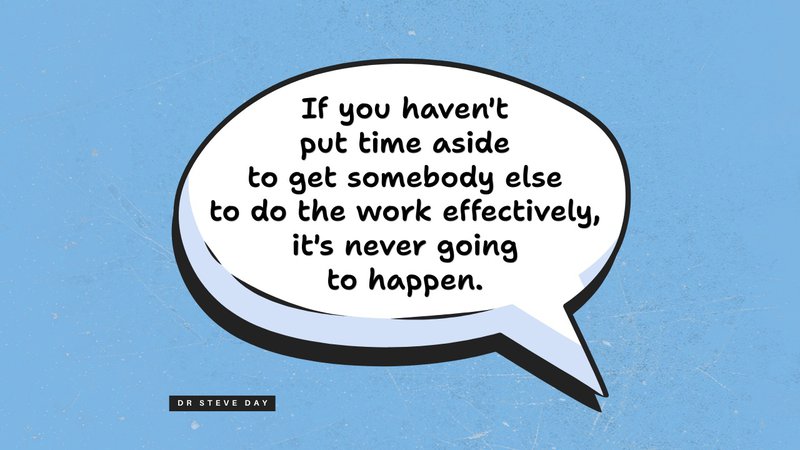
But if you\'re sure that stuff you need to do needs to be done, then you need to then figure out how to get someone else to do it. And if you haven\'t put time aside to do that effectively, it\'s never gonna happen. So the first thing is the time block.
The second thing is knowing how to rapidly or quickly delegate that out so it\'s gonna get done first time and every time. This can be done a couple of ways. One of the simplest ways to do it is to record yourself doing that task the next time you do it. Now, that means just hitting record on your laptop or your computer, record your screen. And then narrate yourself through it. That\'s the simplest way to show someone exactly how it\'s done.
When you\'re doing that, however, you need to make sure you\'re including a few fundamental things. And this is what I call DIDACT. Something I\'ve discussed many times on this podcast. But it comes up so often with my clients when they\'re talking about, \"Hey, this wasn\'t done right.\" and I just go through DIDACT with them.
It\'s a acronym to make sure you actually delegate a task effectively. And so when a task comes back not done to the standard they hoped what would be, I often have said \"How did you delegate this?\" And we go through it and look in the delegation, the task that they gave to their member of staff. Did they include all the elements of DIDACT.
So DIDACT is a Description telling them what they need to do and why they need to do it. So it gives them the Input. So any templates they need, any website addresses, any, information they need to complete a task. It\'s the Deliverables. So what exactly are they gonna produce and where should they put it. It\'s the Access Required. So what logins they need, the passwords they need. Are they gonna share that on a password sharing app? Are you gonna create a user for them?
The Checks that they need to do. So what does good look like? Or what are the things that often go wrong that you should make sure you don\'t do as you\'re doing it? And also the Time. How long should this take? Because if it\'s taking much longer than that, they\'re probably doing it wrong. And if it\'s taking much shorter than that, they\'re probably doing it wrong as well.
So showing someone how to do something with a share screen and making sure you include all that DIDACT stuff will give them a absolutely foolproof way to get that task done. Even if you\'ve never done the task before, if it\'s something new. Or you haven\'t got time to show them how to do it. By recording your screen, for something, you\'re planning on doing in the future, you just want to get it off your plate. As I described, like future planning what you\'re going to give somebody.
Then actually just including all the DIDACT stuff. And being really thorough with that is often all you need to give somebody who\'s intelligent and confident to be able to do the task. You often don\'t need to show somebody how to do it step by step by step. They can always come back and ask you if there\'s any questions.
And that\'s why putting things, onto someone\'s plate that aren\'t urgent means you have time to do that. Yeah, it may be better to show them, but if you haven\'t got time or you want to just move some other stuff off. Or this is a new thing that you\'ve never done before, then you can\'t do that. So don\'t let that get in the way of you just handing stuff over.
So the first thing is making the time to do it. And the second thing is how you do it with, we\'re using DIDACT and screen recording as well.
The third thing is about expectations. It\'s about expecting this not to be done to the highest standard first time. That means that when you have that conversation, you have the expectation that you\'re gonna have to give some constructive feedback. And they\'re gonna go away and improve it.
That should be part of your mindset. Because if it\'s not, you can feel that you\'ve been let down, you can feel frustrated, you can feel stressed. That it\'s actually taking you time to get this done right. Going into a call, a feedback call, a session, a one-to-one, whatever, however you\'re gonna give that feedback and actually discuss it. Or just if you\'re giving, recording your feedback and sending to them. If you go into that situation with that negativity, it will show.
It will cause stress. And that stress is not gonna help that person improve and become better in the future. So their mistakes are things to learn from. And hopefully they will learn from them. The only mistakes that should be frustrating are repeated mistakes. That\'s why on DIDACT we have somewhere the section for Checks. The, C in DIDACT is for Checks.
And if something happens, like a mistake happens, and it was an obvious mistake that you don\'t want to make again, you can stick it in there. So it can\'t be forgotten next time. And therefore, people shouldn\'t make repeated mistakes. Because you\'ve now got somewhere to actually document, you know, \"Keep an eye on that. You did that wrong last time, make sure that never happens again.\"
And therefore, if it does happen again, obviously that\'s a performance issue. And that\'s slightly different from what we\'re talking about here. So by doing these things, by putting time aside each day, by delegating effectively, by having realistic expectations. And finally, by actually reviewing work and giving feedback effectively. That means you are actually helping somebody grow into the person you need them to be in order to take that work off you. And to take ever increasingly complex work off you as well.
The compounding effect of doing this is, well, first of all, I should say that the problem or the reason many people don\'t do this, because it is relatively simple to implement this in your business. But it\'s because people feel, \"I\'m too overwhelmed. I haven\'t got time to do this. I just need to get stuff done.\" But as I said before, that is the trap that you cannot get out of until you take this leap and actually say, \"Look, I\'m going to actually just find time to do this.\"
Once you\'ve done this though, the compounding effect is that you can now start seeing a future where you are moving more and more of your work. And more and more complex parts of your work onto other people. That mindset shift is huge when you see it. I have these calls with clients. As I say, this person I\'ve worked with for many years, I\'ve discussed this many times, but suddenly the penny dropped. And it was just like night and day, the conversation had the two weeks before, and then, when I caught up with her.
And whatever time that is, sometimes it\'s clients, they get it on day one, and sometimes it\'s a little bit later. But when that happens, the change in that person\'s mindset, the change in their energy level when I next speak to them is just massive. So I encourage you that if you\'re struggling now and you\'re still holding onto stuff. Even if you\'ve delegated a lot of stuff before, but there\'s still stuff that you\'re holding onto. Stuff that only you can do, like how could I possibly give this to somebody else to do?
Then take a look at it and think, \"Okay, is there part of that work that I could actually get help with? Could I break this down into a number of steps. And delegate three of the five steps in order to actually move some of that more, even more of that work over?\" And that then frees up more of your time to think about, \"Okay, well, what else could I actually move over?\" Or if you\'re just sat there completely struggling to move anything over, then this is the shift I hope will make all the difference for you.
So hopefully that\'s been helpful to give you a simple overview of one of the most fundamental things that I believe that is very easy to get right. But incredibly hard to get to start implementing sometimes, because you\'re stressed. And it\'s also very easy to get wrong.
And you\'ll notice that I find, anyway, that when I delegate something and it doesn\'t go right, and I end up having to correct it like massively. Or it\'s just like completely missed the target. If I go back and look at actually how did I hand this task over? Did I actually go through and give a proper handover using DIDACT? Or did I just wing it and hope for the best?
Because that few extra minutes, and it really is a few extra minutes, it\'s not 30 minutes or an hour to actually create a DIDACT. It\'s a few minutes once you get the hang of it. Once you actually do that and you then look, or you look back and say, \"Did I include everything? Yeah, I did.\" Great. Okay, now I need to give some feedback and make it better. If I didn\'t, which is 99% of the cases, I go, \"Right, well, if I\'d told them this, then there wouldn\'t have been this issue.\"
So that\'s my encouragement to you. Is to go back to basics, make sure you have this one skill absolutely nailed. And that your managers, if you\'ve got a team, your managers have this skill. Getting them to offload more and more and more. And then that manager, you can then elevate people up.
The same skill is also used when delegating and working with AI. So, when we\'re giving a task to AI, we need to be super clear on what they\'re doing. Do they have all the access they need? Do they have all the inputs they need? And what should they, or what does good look like? How long should it take is one of the only things that is slightly different.
So instead of time being a temporal thing, we can use tokens, as in how many tokens should this take? And so that way we\'re not burning tokens on a menial task. We can actually limit, say, \"Hey, don\'t, use too many tokens on this.\"
That\'s the only difference, in my opinion, between delegating to an AI or to a human. Because with an AI, the work goes up front, it goes and does the work. And then you have to review that work. Give feedback as the key so that they can improve things for next time. So process is exactly the same, whether it\'s humans or AI.
Cool. Hopefully you found that useful. If you have, please do remember to hit subscribe and share this with anyone else you know. Who you feel would benefit from learning how to delegate more effectively. To create more time in their life, to start offloading some more work. And really to live with more presence, purpose, and peace.
Thank you very much.
VALUABLE RESOURCES
Get free access to our DIDACT Framework for quickly capturing the HOW of tasks and delegating them effectively at sys.academy/guides
LINKS TO CONNECT WITH THE HOST
- Podcast: https://www.systemizeyoursuccess.com
- Website: https://systemsandoutsourcing.com/
- Facebook Group: https://facebook.com/groups/systemsandoutsourcing/
- LinkedIn: https://linkedin.com/company/systemsandoutsourcing/
- Instagram: https://instagram.com/systems_and_outsourcing/
- YouTube: https://youtube.com/@drsteveday42
- TikTok: https://www.tiktok.com/@drsteveday42
ABOUT THE HOST
Steve moved to Sweden in 2015 and transformed how he ran his businesses – switching to a fully remote model. A former NHS doctor with a background in computing and property investing, he now helps overwhelmed business owners systemise and outsource effectively. Through his courses and coaching, Steve teaches how to automate operations and work with affordable virtual assistants, freeing up time and increasing profits. He runs his UK-based businesses remotely with support from a team of UK and Filipino VAs, and is passionate about helping others build scalable, stress-free companies using smart systems and virtual support.
For more articles related to outsourcing and delegating tasks effectively, you may also like:
The Game-Changing Approach We Use to Rapidly Delegate Tasks That Get Results
How I Stopped Doing Everything Myself – and Outsourced to My First Virtual Assistant
Published: 13 August 2026 · Last updated: 1 October 2026