Published: 21 May 2026 · Last updated: 21 May 2026
AI challenges are testing many business owners right now – but the answer may not be rebuilding everything from scratch.
You've spent years learning this.
How to delegate and build systems.
How to write things down so others can run them.
And how to hand work off without it dropping.
Then AI showed up.
And a quiet voice started asking – is any of this still worth doing?
The fear that everything you've built is about to be obsolete.
Then today, I was setting up an AI agent inside Asana.
Giving it clear goals.
Deliverables.
Context about the business.
Boundaries on what it could and couldn't touch.
Checking the work.
Giving feedback when it missed the mark.
Asking it why it made the choices it did.
Updating the instructions when it got things wrong.
Then I realised-
That list is the exact way I’ve been delegating to humans for years.
Same context and boundaries.
Same culture and values.
And same feedback loop.
AI doesn't change any of it.
If anything, it needs it more.
Because it doesn't have the common sense a human does.
On this week's podcast, I walk through how to work with AI.
Without throwing away the work you've already done.
Why the skills are the same.
Why they matter more now, not less.
🎧 Listen to the full episode – you might walk away feeling a lot lighter.
KEY TAKEAWAYS: Navigating AI Challenges Without Losing Your Business Foundations
- Tame AI FOMO Before It Derails You: You can´t afford to ignore AI, but you also don’t want to blow up a working business just because others are sprinting ahead with AI. Instead of reacting to the hype and giving in to FOMO, make calm, deliberate decisions.
- Adopt AI in Bite‑Sized, Relevant Steps: Measure how far you’ve already come, then pick the next practical use case for your business instead of chasing every shiny AI possibility.
- Make AI Work Through Familiar Workflows: Design simple, human‑friendly interfaces, e.g. task boards, so your team can “delegate to AI” without needing to become technical.
- Manage AI Like a Team Member: Set goals, boundaries, permissions, and feedback loops for your AI agents just as you would for humans, so they’re powerful but safe and aligned with your culture. Without human oversight, AI can easily go off in the wrong direction.
- Don’t Build in Isolation: Plug into communities, open‑source tools, and experienced guides so you can shortcut the hard technical work and avoid trying to figure AI out alone.
BEST MOMENTS: Honest Conversations About Real AI Challenges
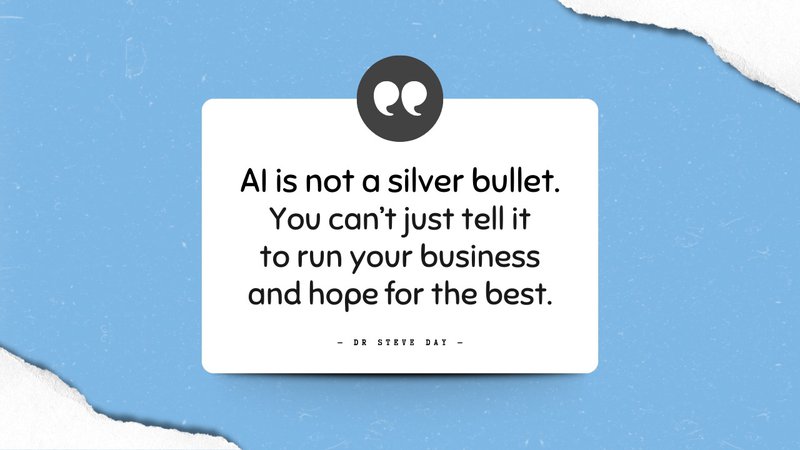
00:04 – 💬 “ The AI FOMO epidemic is rampant in the business world right now.”
03:52 – 💬 “ The AI agent is going away, doing them and then reporting back, just like a human would.”
07:35 – 💬 “ We sometimes lose sight of how far we've come. We focus on the goal that's in front of us, and that goal never, ever can be reached.”
21: 32 – 💬 “ We can't just plug AI into this. It's got to be an interaction between the AI and the humans.”
TIMESTAMPED OVERVIEW
00:00 Intro: Facing AI challenges and realisations
05:18 Managing staff access and training
07:41 The gap and the gain philosophy
12:27 Discussing AI tools and resources
15:02 Using AI to Enhance Business
16:32 Training and guiding new employees
21:23 Deciding on technology solutions
Episode Transcript
Please note: This transcript was generated using automated transcription tools and may contain typographical errors or inaccurately captured words or phrases.
Dr Steve Day: The AI FOMO epidemic is rampant in the business world right now. I can\'t turn on my computer or my phone without being bombarded with all the ideas of things that I should be doing or the things that I\'m missing out on. There\'s so much fearmongering out there. So today I wanted to take a pause. I wanted to explain some of the challenges that I\'ve faced. The real challenges of implementing AI, that it\'s not all rosy, it\'s not all easy, and it doesn\'t come without a significant costs.
I also wanna explain some of the real challenges I\'ve had to go through internally. About our identity as a business, about what it means to what we should be doing right now. In terms of like, should I be sacking all my staff and focusing on AI?
Should I be pivoting to get onto this AI bandwagon and make the most of it while, you know, we\'re in the tide of this new AI era. There\'s so much challenge out there. So many things that have caused so much pain and just suffering in late nights. I wanted to actually share some of it. Because I think it\'ll be helpful to understand the challenges that I\'m going through.
Because I\'m pretty sure you will either have already been through them. You\'ll be witnessing other people going through them, or you\'re about to go through them. Because what I\'ve experienced isn\'t unique to me. I spoke to many business owners about this stuff and they\'ve encouraged me to share this with you today.
Okay, so what I wanna talk about today are the challenges that I\'ve faced over the past couple of months especially. But actually over the past, say year or so, of really getting into AI. Of the FOMO that\'s out there at the moment, of the fear of missing out of all of this stuff, of that shiny penny syndrome. And what effect that is happening on me internally, my business, and also the direction we\'re going.
Also that moment when I actually thought, wow, should I just sack my business off today? Start from scratch and build an AI first business from day one. Is that actually the way I should be looking at the world now. And everything I\'ve done so far is just no longer be gonna be a value.
I wanna discuss that because I think, again, many businesses I\'ve spoken to, business owners I know I\'ve spoken to, are going through these same fears and challenges. With their current belief in what they do and what they know. But there\'s also some really positive stuff here. About how going through this journey made me realize, that actually the human-centric stuff that I have been learning and teaching and sharing with people. The stuff about how to actually get the most out of people, be a human with humans, they\'ll be empathetic and be considerate.
Those things actually are still hugely invaluable, if not more than they ever have been. So. I think is the silver lining to some of this. That yes, AI can do great stuff, but we need to know how to work effectively with the AI. And that is what I want to get into later as well.
So first off, I wanna hit in with the challenges. Like over the past few weeks, I have slept very little. I have been totally overwhelmed by Claude Code. Yes, it can do incredible things. But at this moment in time, it doesn\'t come without some costs. There is some setting up to be done. There is some learning to be done. To be honest, there\'s a lot of both.
But if you get it nailed and you have your setup done, and it only takes now if you know what you\'re doing a few hours. Then you can start actually playing around with it. And the stuff you can do compared to what I could do with the ChatGPT is just mind blowing. Like today, for example, I was demonstrating to one of my clients that I\'ve set up a task board on my Asana task management app, and it has an AI agent attached.
And I\'m slowly starting moving tasks onto this board. And the AI agent is going away, doing them, and then reporting back just like a human would. If they\'ve got issues, they flag them up and ask questions. If they haven\'t, they complete the task, and mark it as done. These simple things, like it\'s creating a human environment for me to be able to interact, for my staff to be able to interact, but utilizing the AI.
So when I\'ve got this sort of interface nailed, it\'ll mean that my staff won\'t need to be, like understanding how the technicalities of the Claude work in the background. Or even having to open up Claude Code on their desktop to be able to use it. They\'ll just delegate work like it would to anybody. And I think that will make this so much more accessible and usable. We\'d have to reteach like how people interact in this time.
I think over the years people would just become, it\'ll become second nature, just like using the internet is now about using Google, for example. And many people using Claude AI or ChatGPT, the chat interfaces, that\'s second nature as well. But this is going a level deeper. And the understanding of the power of this stuff.
And actually maybe I don\'t want to give the power of what a Claude Code can do to my staff. Because it can do a lot. Given the right permissions, it can pretty much do anything you want it to. Rewrite your entire hard drive or delete your entire hard drive, if you aren\'t careful. It can basically set up delete apps, add users, whatever you give it permission to do, it can go away and do without your intervention if you\'re not careful.
Again, I\'m saying if you\'re not careful, because all of these things are preventable. But going cart plunge and allowing people to have access to everything is not the approach you might wanna take. Especially with new members of staff.
So this approach I\'m going for is trying to bridge the world of the human in the world of AI. With an interface that feels very familiar to my staff, is overcoming that one of the biggest challenges. Which is how do I actually train on my staff to use this? How do I get them to set this up in their working environments, how do I give them the right permissions? How do I set up these things called GitHub to be able to store my files in the cloud and sync them with the people that are using them?
There\'s so much technical stuff to get your head around, to get this stuff properly working. So if I\'m gonna work on that and learn that, or it\'s gonna be like a dedicated, like cool AI dude to come and actually do that format, that\'s great. But then having to turn my entire team on the technical stuff may not be actually practical in the short term. So this is one of the things that I\'m going for to try to actually overcome that. More of that to come in the future as we get it properly rolled out.
Second challenge is, actually not a challenge, the second problem I\'ve had at the moment is the FOMO. Like literally, every single day someone will tell me what they\'re doing with AI. My coach, for example, will show me, hey, you\'ve just built this amazing thing that does X, Y, Z. About building websites or doing marketing research reports, or analyzing entire business.
So my clients are telling me that they\'re set up the whole of the EOS Traction System by Gino Wickman into their business with an AI agent. Which is basically coaching them on AI, on EOS better than an EOS coach could do. EOS if you\'re worried, if you\'re wondering, is the Entrepreneur Operating System designed by Gino Wickman in the book \"Traction\". And that client, for example, is just mind blown, like blown my mind about what\'s actually achievable with this stuff.
And I\'m getting there, but I\'m also two steps behind in so many areas. Then I turn around and look back and there\'s people who haven\'t even used AI chat bots yet. And I feel so far ahead of them. And that is the, whole problem with FOMO. Is that we sometimes lose sight of how far we\'ve come.
We focus on the goal that\'s in front of us. And that goal never, ever can be reached. It\'s constantly moving away from us. It\'s the gap and the gain philosophy by the book with the same name, which I can\'t remember the title of, the name of the author, sorry. But the gap in the gain is about like, stop looking forward an arbitrary goal. Whether it\'s a goal that you\'ve set or that you are, you know, seeing somebody else\'s doing and then trying to move towards it.
Because they\'ll move away from you and probably actually faster than you move towards them. If that\'s what they\'re doing with their, you know, entire focus or whatever. And if the goal that you set is like a financial one that\'s never gonna be reached. You\'re never gonna get to a financial goal and go, awesome, done that now, no need to earn any more money.
You are gonna always wanna actually continue. Whether it\'s a financial goal or you may have a own new holiday goal. Things always change and move. So you never actually reach a point of complete serenity when you don\'t feel you need to move forward. Unless you go down the route of being a enlightened monk, et cetera. And actually take more value and joy from living with presence, purpose and peace. If you go down that route, then great. But for most of us business owners, that ever never really happens.
And so the FOMO thing is I think something we construct in our own heads. We think that we are falling behind and actually if we just turn around and look back, we may realize how far we\'ve come. The fact that you are aware of AI, that you\'re thinking about in your business, you\'re actually ahead of many people. What we need to now do is to make this real. What\'s actually relevant to you, what do you need to know now?
Do you need to get into things like Claude Code now? Or actually is using something like ChatGPT or Claude Chat actually gonna be able to augment your existing staff. To a point where their productivity goes through the roof. Without you having to think about all of this technical sort of really full on AI automated type of behaviors. And it\'s the same thing that happened with automation.
I\'ve got clients now who haven\'t automated a single part of their business when they meet me. These are clients that have been going on for decades. And this is in a time when automation has been around for even more decades. It\'s not a new concept, but it completely revolutionizes business. AI is just the next evolution of that.
And there will be businesses 20 years from now that aren\'t heavily using AI. They may be using it in bits and bobs, but they\'re probably not gonna go full all in. Unless everybody suddenly becomes a techy geek and they wanna just focus on this stuff. Or they suddenly, you know, change their personality types. To think, I want to invest my time on hiring a tech geeking to my business and get them to actually build this for me.
But that hasn\'t happened to date. Whether it\'s been websites, technology like chat bots, or AI introduction to this point, or automation using CRMs. Like these things that many of us business owners think, well, of course everyone\'s using them. How could you run a business without those things?
From my experience, there are many, many business owners that have not even touching the existing technology that we have available. Let alone opening up this huge kind of worms, which is the world of AI.
So my point here is just be proud of the fact you\'re on this journey. You\'re listening to this podcast. You haven\'t switched off when I mention the word AI thinking, oh, that\'s not something you wanna ever get involved with. Because the fact you\'re here, the fact you\'re still listening means you are on this journey already. You are becoming aware of the stuff that is available or is around.
Like me telling you can actually build something that your staff could interact with your AI as if that AI was another member of staff. Hopefully, that\'s opened your ideas to, or your eyes,. sorry, to what\'s possible. Because when someone told me that concept, I was like, that\'s awesome. I\'m gonna go and build that today.
If that\'s like you, then great. Connect with me, we\'ll have a chat and we\'ll see what we can produce together. More, you know, the more minds the merrier on this stuff. It\'s just so vast and so the possibilities are so endless. That I\'m seeing such a, an amazing collaboration as well between people.
Like my coaches on AI, my marketing technical sales coach, my ex clients, the tech more technical ones. Everybody\'s sort of coming back and we\'re having conversations and sharing stuff in a way that we\'ve never done before, which is massively encouraging. It\'s more like I\'m a part of a developer community now. Even though we\'re actually doing stuff quite high level. It\'s allowing me to actually be involved and share.
Because, there\'s no one right way of doing this stuff. And you might figure out a nuance of the way you are doing something that someone else could pick up and plug in or vice versa. And it makes your thing 10 x better. That\'s a cool thing. And I think, so being aware of that makes the whole journey into AI less scary for me. Because I know that I\'m not doing this alone.
There are places out there, whether they\'re paid communities or free communities, like where people are sharing ideas. Like an astounding amount of stuff is being shared for free on places like this. This thing called GitHub, which you\'ve not really heard about or I\'ve not used it anyway. I had heard about it, not used it. And there\'s people in there sharing amazing tools.
Even like the founders of AI are on there sharing some stuff. This guy, this amazing LLM system using obsidian that the founders of, I think it was of OpenAI. He shared the other day and it\'s gone viral. You can, I\'m sure you\'ll be aware of it if you are in that sort of world. I\'m in the middle of just setting up now. I\'ll be doing a post on it shortly because it looks amazing.
But like the fact he shared this entire thing, it probably took him ages to write, and it\'s for free. And everything you could imagine. Like SEO audits, or designing brochures, or doing thumbnails for your YouTube videos. Whatever you can imagine, like running analysis of your financial reports, doing productivity based, operational based tasks like admin tasks, whatever.
People have built like agents for doing all this stuff. And you can literally just plug them in. It is just mind blowing what\'s available. But obviously that does come with a little bit of technical challenges along the way. So, you know, I advise get some help. And there are loads of cool people out there helping people do AI. If you\'re interested, you can come and have a chat with me. But if not, there\'s loads of other guys out there that are doing, or girls as well, people, I mean, that are doing cool stuff.
So back to FOMO. So, where does this leave me with the FOMO thing? The FOMO thing is, like I just said, I have just told you a bunch of stuff you could be doing. And if you\'re sat there thinking, God, that\'s not even on my radar. Like that can now fill you with a bit of FOMO. And so that can actually lead you to make bad decisions.
I have done this time and time again in the business. And I\'ve done it again now. It\'s made me start thinking like, okay, should I be ditching this? Should I be just moving on to something else? Should I not be actually pursuing what I said I was gonna do for these quarterly goals? Because actually this new things come along I\'m aware of, and now I want to focus on that. Because that\'s my ADHD brain all over. I get distracted instantly onto the next shiny penny, and that\'s where I wanna put my focus.
It takes huge discipline for me to actually stay in the track and not get distracted. Especially when the shiny penny is as big as the whole AI boom of 2026. And I say 2026 because things have changed suddenly with Claude Code, and the way that is interacting. And all the stuff I\'m talking about with like sharing of ideas and content and skills as they\'re called. It is just a mind boggling of the possibilities of it now.
So the FOMO is there. It is real. But it\'s also worth noting that to do this and jump in and go all in, like sack all your staff and use AI, that\'s not gonna be a reality for most people. So understanding, like I was saying before, how we adapt this in a piecemeal way, keeping ahead of the game. So we\'re still actually adopting some of these best practice of using AI.
And then maybe thinking about if you are not a technical person yourself, maybe hiring somebody that is. To actually start looking at applications of AI that could improve even more. Speaking to a coach, speaking to someone who knows a bit more about it. Describing your business, say like, what are the opportunities in AI here?
Someone who\'s not just gonna spout, you know, nonsense like you, someone who\'s actually gonna sit down, be sensible about this. And also explain the challenges and the problems and the, you know, the things you\'ve gotta overcome when you\'re actually working with this stuff.
But I think that\'s a really good way to look at it. Rather than thinking, oh, I\'m just gonna scrap everything, which I definitely did over the past couple of weeks. But what changed my mind about scrapping everything. And this is the silver lining I mentioned before. Which is I went through some real sleepless nights. Some real soul searching stuff. That everything I\'ve been thinking about is about how to delegate, how to systemize a business.
You know, often thinking about staff members and virtual assistants and everything. And suddenly it clicked that everything that I teach, everything that I\'ve thought of. Like how you turn vision into operational flow, that is more relevant than ever. Because what I think some people that aren\'t into AI don\'t realize is AI is not a silver bullet.
It\'s not like, hey AI, go run my business, and then off it goes and runs your business. You need to give it clear goals. Clear deliverables from tasks. You need to accept boundaries where it can work, you need to give it context. You need to give it the grounding and understanding about how your business culture works, you need to give it the values of your company. So it understands how to act in a way aligned with your business\'s vision.
You need to train it up. Give it tasks, see how it functions, learn from that, and then build up the complexity of the work it is doing. We need to map things out in a way that it can understand how do parts of your business link together. How do you give instructions, how do you check work\'s done. Is there any specific things that should be checked before your work is done and handed in or completed. Like all of these things I\'ve just described are literally the things that I have been teaching how to help humans do this stuff.
How to get stuff out of your head as the business owner and onto someone else\'s plate, onto someone else\'s play. Like that is what we\'re talking about here. And doing that in a really managed way that doesn\'t become overwhelming for you. And if those skill sets are just literally transferrable to the AI world, and in some ways are even more important.
Because we\'re not gonna have the hopefully common sense of the human so much. I\'m not saying, AI doesn\'t have some appearance of common sense. But often it will act because you\'ve asked it to. Claude Code is pretty good at sort of checking in with you. But when you give it, when you can take away like all check in permissions and let it go. And it can do some pretty crazy stuff, so you\'ve gotta be careful.
But just like a human. Like humans can do anything they want. They can do crazy stuff. They can make decisions that I\'m gonna sell all the company\'s assets off. Like that is something that a person could do if they went a bit crazy. So we have to be careful. And we have to train people and we have to keep eye on them. We have to monitor people.
Do they look like they\'re getting a bit psychotic or actually are they looking like they\'re pretty calm and they\'re okay? Can they be given the company credit card or not? Like these decisions have to be made. Whether it\'s a human doing this, or an AI doing this. And these are the same decisions that happen with HR, the same with management, the same with delegation, the same with systemization. All of these things are as relevant, if not more relevant, in my opinion, with the advent of AI compared to how they have been with humans. Yeah.
And one more thing, like when you are working with an AI, like you give it a task. Or could be a complex task, but let\'s just keep it simple, you give it a simple task to do. And it comes back with a result.
Now, the better your instructions were, whether you call that a prompt or what\'s called in Claude world, the MD file, like the markdown file of how you explain what you want this thing to do. The better those instructions are, the more likely you\'re gonna get a good result. But we often don\'t. Your instructions weren\'t clear. It misinterpreted something. You didn\'t provide all the context it needed.
There\'s a countless reasons why you did not get what you expected to. So then we have to be patient. We have to be patient, we have to give it feedback. And we have to be able to look into the mind, so to speak, of the AI and think, why did it do that? We need to ask questions. Why did you do this instead of this? What was your reasoning here?
Get the AI to question itself. And then to repair what wasn\'t right before. That is the process that you say you have with a human. Human does work. They give it to you. You give feedback. They correct their internal understanding of that process, and they try again.
You then update the system when it\'s actually proven to be correct and now we\'re good. And now going forward, that task is done correctly. That is the same way that we interact and deal with AIs and nothing has changed. In fact, that has probably become more important.
Also, handovers. We aren\'t yet living in a world where many businesses are entirely run by AI. I did read a story about a guy who run a billion dollar business as a one man band. However, I think he\'s under a lot of lawsuits at the moment because he was selling some medical product. I\'m not gonna get into the details.
Anyway, there are very few businesses that are running without humans. So at some point, there\'s gonna be a handover between a human and an AI, and an AI and a human. And those are just as important as handovers between humans and humans. And it\'s one thing that most small businesses do really badly.
So spending time thinking about how those interactions happen, will save work that\'s getting lost or just being delayed. And actually understanding, okay, we can\'t just plug AI into this. It\'s gotta be an interaction between AI and the humans. And that\'s super important not to miss out on, or not to forget.
Cool. So today, I hope I\'ve inspired. I hope I\'ve shared some of the challenges that I\'ve had. I\'m gonna go deeper into some of the specific challenges I\'ve had in future episodes. Because, for example, choosing whether I\'m gonna be using a virtual private machine, a virtual desktop, a Claude cloud-based software solution. Or a local solution on each of my and my staff\'s machines. It was one of the biggest headaches I\'ve been to in, I can\'t remember how long it\'s been since I actually had such a headache trying to get my head around all that.
So I wanna share that journey just once I\'ve got absolutely nailed. And I know that I\'m not gonna change my mind again. That has been probably days and days and days, not probably, it has been days and days and days of wasted time and effort, not wasted, time and effort put into understanding that. And trying things out and seeing what works for our particular circumstances. And a bunch of other stuff besides. Which I want to go into.
And I also wanna share some of the cool stuff we\'re building over the coming episodes. Like for example, how we actually went through and built the AI agent inside our Asana. And it\'s all powered from Claude in the cloud. But it\'s, we\'re able to interact with it. And when that starts building out, as I\'m getting into some more stuff, I will start sharing that. And I hope we can do some YouTube videos to show how to build that stuff as well.
So do keep listening. Get subscribed. Don\'t miss out on this stuff coming up in the future. I hope you found today useful. Please, if you have, do share it with anyone you know who runs a small business. Who\'s interested in learning more about how to live with more peace and presence and more purpose. And do so by utilizing AI, automation, and virtual assistants, and systems.
Thank you very much indeed. Take care. Bye.
VALUABLE RESOURCES
Join our private, focused, and supportive community designed for freedom-driven entrepreneurs at join.sys.academy
LINKS TO CONNECT WITH THE HOST
- Podcast: https://www.systemizeyoursuccess.com
- Website: https://systemsandoutsourcing.com/
- Facebook Group: https://facebook.com/groups/systemsandoutsourcing/
- LinkedIn: https://linkedin.com/company/systemsandoutsourcing/
- Instagram: https://instagram.com/systems_and_outsourcing/
- YouTube: https://youtube.com/@drsteveday42
- TikTok: https://www.tiktok.com/@drsteveday42
ABOUT THE HOST
Steve moved to Sweden in 2015 and transformed how he ran his businesses—switching to a fully remote model. A former NHS doctor, with a background in computing and property investing, he now helps overwhelmed business owners systemise and outsource effectively. Additionally, through his courses and coaching, Steve teaches how to automate operations and work with affordable virtual assistants, freeing up time and increasing profits. He runs his UK-based businesses remotely with support from a team of UK and Filipino VAs. He is also passionate about helping others build scalable, stress-free companies using smart systems and virtual support.
For more articles related to AI challenges and implementation in business, you may also like:
How to Keep Your Team Relevant and Future-Ready in the Age of AI